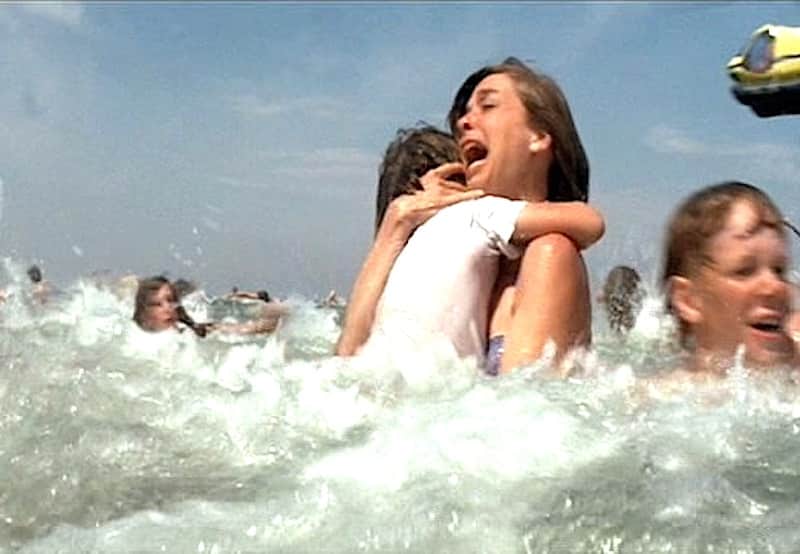

"An abnormally high number of sharks."
A bumper season for Great Whites in Australia, to be sure.
Just two weeks after the second-biggest Great White ever recorded in Western Australia waters forced the closure of Cottesloe, another Great White has put swimmers and surfers at the same beach back on the sand.
The White was three-hundred feet offshore when it was spotted at three forty-five, prompting the now familiar sounds of klaxons and megaphones and the scene of swimmers exiting the water, with haste.
Forty-five minutes later, the White had disappeared and the beach was reopened although swimmers were especially tentative, few willing to venture into depths beyond their waists.
Two weeks ago, Peter Godfrey from the Department of Fisheries had told 9News, “It’s very rare to have such a big White shark so close to the metropolitan area.”
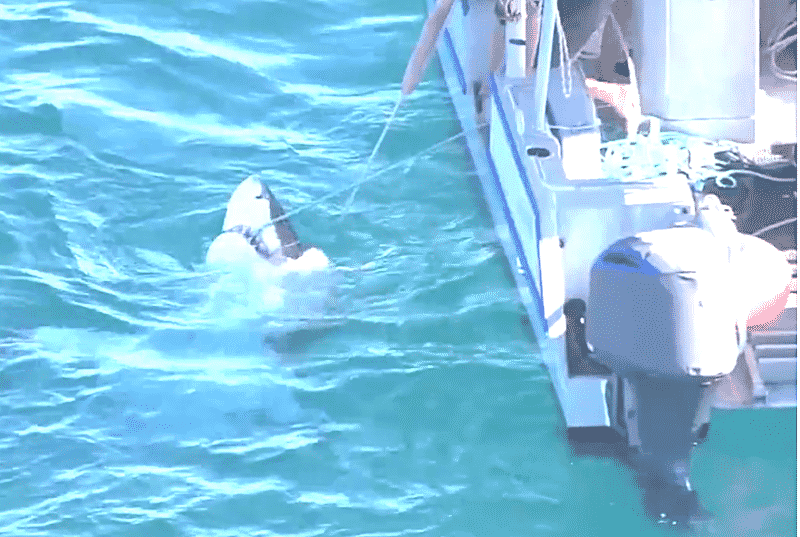
And, Surf Life Saving WA had warned of an “abnormally high number of sharks.”
The “mammoth” Great White swimming so close to a popular beach, it said, was “not an isolated incident.”
For generations, pretty Cottesloe Beach, seven miles (11 km) from the centre of Perth, was known for its dreamy grass terraces and even dreamier afternoons in its hotels’ beer gardens, a tangled sea of brown bodies and loose lips.
Then, in 2000, one year after Great Whites became protected by law, a swimmer, Ken Crew, was attacked and killed by a fifteen-foot Great White in waist-deep water and in front of other swimmers, early morning joggers and cafe diners. He bled out in the arms of a Catholic priest on the beach.
Also on Christmas Eve, Bunker Bay, an awesomely pretty crescent of white sand and green water almost at the tip of Cape Naturaliste, a little north of Margaret River, the same joint that hosted an attack on a surfer by a “freakishly big Great White” in July, was closed due to a lingering Great White
Great White stocks appear to be abundant, at least anecdotally.
Commented on Disqus? Log out, tap the Disqus button, and your old name and comments come back. The box is ours.
Your comments are still here. Every one of them.
Twelve years of BeachGrit comments came across from Disqus. Connect and we will show you how many are yours. We get your username, nothing else.
Connect Disqus to reveal.
Caption:
“An abnormally high number of sharks.”
Jesus~F**Kin’~Christ, man,
your shark phobia is at an all time high, it appears!
Question: How many pep’z, in your hot Christmas summer,
over thee last week, were biten +/or killed by Great White Sharks??? None?
hmmm…
That large shark just did not wanna eat any of you ‘shrimp on the barbie’ pep’z,
i guess, but ah, hey, keep on fear~mongerin’ for clicks, if ya need too…
I just really hope the guy that spotted that shark was the clown snorkeling on front of paddleboard whilst his partner paddled – that be best!!
Could go to palm springs and cry “cowabunga” !! will they add sharks? https://www.npr.org/2020/12…
Listening to that makes you realize jut how little the public knows about modern day surfing.
be careful wishing for a white Christmas. Santa is very busy this time of year. best to be more specific.
Firstly, my boys are in the Torquay caravan park as we speak. Not many reports, but it happens.
Son #1 was in WA on a school trip just before the Wuhan Virus hit Oz.
I phoned him and asked where he was.
He said Cottlesloe beach.
Stuart Bedfod Browns mother had just tapped her fellow clubbie swimmer on the shoulder at waist high water at Cottlesloe when the shark grabbed him, and the report said the shark was dredging sand he was so swallow.Much rather go out being smothering in titties.
Hands off. Crazy eyes is mine @3;46
Just cancelled my flight to Rio. I bet I get there first, and I’m bringing roll!
Wonder where this is, Serbia? A few beautiful girls if you can get past the jacked teeth.
Maldives resort, training for a boat trip to follow…. honey moon couples etc…. no random hot women to chat up.
Decided to surf at midnight during 3/4 moon and not a breath of wind, well overhead.
I walked by the bar to the paddle out and there were a half dozen supermodels partying full tilt, women I had not seen in the week I had been there. Always wondered why the bar was open till 3AM as the surfers all cleared out after dinner to sleep.
Found out some Russian oligarchs were there and brought a coven of working girls as entertainment and they held the bar open till 5 AM for the entourage.
Could see the bar plain as day from the lineup and more girls were pouring in, dressed way too slinky for a beach resort…. loud as heck too, full raging party.
Now I knew why the Bangladeshi bartender was always so tired. Dude was working a 20 hour shift.
It was so hard to go to my room after I got out at 1 AM ish…. what a raging party, but the body guard dudes looked unfriendly while the girls required very little prompting to yell and dance in the sand.
We made a point of walking out the next evening to check it out and have a beer at midnight. So crazy and they were doing coke openly.
Eastern Europe is holding.
Lithuania
Lithuania