

Goes to film, ends up farming coconuts…
What’s your experience of the Mentawai Islands, those beautiful objects unveiled to the world by the surf pioneer Martin Daly and the retinue of famous guests on his boat, the Indies Trader, back in the early nineties?
Let me guess.
You get waves. You drink beer.
If it’s flat the skipper takes you up river to see how the little brown fellas still live. You’re delighted by how primitive it all is, throw a small amount of cash at souvenirs you don’t want (Who can say no to those pleading brown eyes?), and scurry back to the air-conditioning and movies of your floating palace.
I remember, once, throwing a terrific tantrum when the waiter on my vessel attempted to serve my afternoon gin and tonic with the portions askew. (Too little gin, an abundance of warm tonic.)
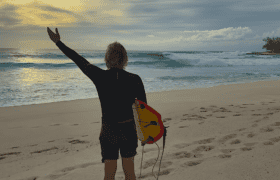
One surfer who didn’t follow the usual behavioural pattern of visitors to the Ments was Rob Henry, a surfer from Melbourne. He went there filming, met a local and was entranced by the whole indigenous trip, went native himself.
“There was a young Mentawai named Andy who had been working at the resort for a year, and he just had this incredible connection to the land and what I thought might be to his culture and freedom in his eyes that was something I had not seen in a long time.”
Rob soon found himself in a remote village farming coconuts, living with a community who didn’t speak English.
“I was interested in finding a village that was as far removed from the tourism as possible. At the time I didn’t know much about the culture or the area.
“I didn’t know the language either. I was directed to this particular village, so I arrived there and it was incredibly overwhelming and frightening and challenging.”
Rob eventually learned the native language and embedded himself in the community. He learnt more about the tribe’s traditional belief system, Arat Sabulungan.
“They believe that all natural things have a spirit and if a human was to pass away, their spirit would go out into nature and become part of nature.”
The Mentawai culture became threatened after 1945, when Indonesia gained independence. The new Government forced the Mentawai to abandon their traditional beliefs, and select one of its official religions instead: Islam, Christianity, Catholicism, Hinduism or Buddhism.
The decades that followed eroded away the traditional Mentawai way of life, creating a new generation of Mentawai without the full knowledge of their Indigenous culture and beliefs.
“It is being lost,” Rob says, “It’s still alive within the elders, and it skipped one or two generations, a lot of Mentawai – particularly the elders still have this knowledge – and they want to pass this on to the next generations.”
Mentawai are now able to live freely, but the effects of a “skipped generation” have been profound, Rob says. He hopes his documentary As Worlds Divide, filmed over eight years, will help to shine a light on the Mentawai community.
“I learnt so much, I learnt how little is needed to be happy. It certainly doesn’t come from anything material. It’s really within yourself and your relationships with family and friends, and I think with any Indigenous culture that’s why they’ve been able to survive for tens of thousands of years.”
It’s a beautiful story.
Spend ten bucks and buy the documentary here.

Commented on Disqus? Log out, tap the Disqus button, and your old name and comments come back. The box is ours.
Your comments are still here. Every one of them.
Twelve years of BeachGrit comments came across from Disqus. Connect and we will show you how many are yours. We get your username, nothing else.
Connect Disqus to reveal.
8 years!!!
Ive paid $3500 for 10 days….this guy owes some serious AirB&B cash to that village ..
Is that a Maori tattoo on his shoulder? Has he tried this before?
It must be intimidating as fuck to hang with a 4’11” Mentawai woman who has size 14″ feet.
The Mentawai like him hanging around because he’s more of a challenge to jump over*. On the downside, he’s caught a few double footed flying kicks to the face when jump attempts accidentally went wrong. Or did they?
*Mentawaiians like to jump over things as a ‘sport’. I saw it on a surf vid somewhere, when the surf went flat and the ‘protagonists’ ventured away from the beach. That’s pretty much the limit on my exposure to their culture.
You’re confusing the Ments for Nias.
That right there is the problem with relying on surf videos for cross cultural education.
We really need a triple upvote button at times…
10-1 odds this Rob Henry guy lands a job at The Inertia near Venice Beach, CA within the year. He’ll then live with the homeless population near Venice Beach, CA and get even better tattoos.
If he goes to Venice some yoga chick will likely scoop him up and use his story from the mentawai bush to help lend credibility to her and her eco snack business that she will bring up at every party art show and fund raiser they attend.
so true
Those little devil worshippers need to be christianized.
Ah! Yes. Wasn’t sure what side you were taking. Carry on.
Good reference, but not sure the comparison is fair.
I was going to write: ‘white saviour complex’. And then i got started on a critique:
This is a classic case of surf colonialism albeit behind a well-meaning white saviour mask. It is a classic case of colonialism because in the first instance the Mentawaii peoples are spoken about, in a way first made famous by Roland Barthes in his formulation of “gossip” and later extended by Trinh T. Minh-ha. Barthes describes “gossip” as a mode of dialogue in which “we are speaking together about others” outside of their presence or participation in the conversation, the effect is to reduce absent and annul those of whom one speaks. Notice how the ‘I’ becomes pronounced in the above PR and in the film? Also, the filmmaker takes on a role of translator into Western epistemic systems rather than leaving us uncertain and unknowing and thus unprivileged in the encounter. Such documenting of Indigenous peoples constitutes a form of colonial “gossip”, voiding their status as subjects and proposing them as merely and pre-eminently objects of imperial rhetoric and fascination. Mick Dobson explains that Indigenous peoples continue to be the object(s) of a continual flow of commentary and classification, and such documentaries are colonising in that they continue the preoccupation with observing, analysing, studying, classifying and labelling these peoples to be consumed by the Western gaze. Under that gaze, their lives change from being a daily practice to being “a problem to be solved”. Gayatri Spivak sees this process as part of the broader project of imposing the universalising “world” view of imperialist expansion and conquest upon “supposedly uninscribed territory”, hailing Indigenous peoples and cultures onto the global stage in forms that assume their invisibility and diminishment independent of imperial epistemological frameworks. Marcia Langton puts it another way: “[t]he citizens of the imaginary White continent speak of Aborigines in the past tense, as if they can wish us to death” (2003: 83).
Then I thought, I am over-thinking things, he is a trying to do something good, I am being worse given I have no right to interfere in his relationship with these people who can decide on their own what they want from the encounter, and spilt rum all over my copy of Les Damnés de la Terre and pith helmet, damn it.
Pretty slick your rhetoric here – you get to both sit back and judge AND be the cool pragmatist. Notice how the “you” became pronounced? In the manner the lady who cleaned Roland Barthes’ toilet would call hipster grad student intellectual bean-flicking ….
Hypocrisy is an art!
Yeah I operate at about a Rembrandt level in that respect ….
more like a finger painting child
Feck me, just checked his feed, hes gone off the deep end. Kind of sad really.
Bloody immigrants stealing jobs off the locals…
*coconuts*
I’m disgusted! How will he get a home loan from the bank manager with all that ink?
Fred doth protest too much. Like his mate Tony.