


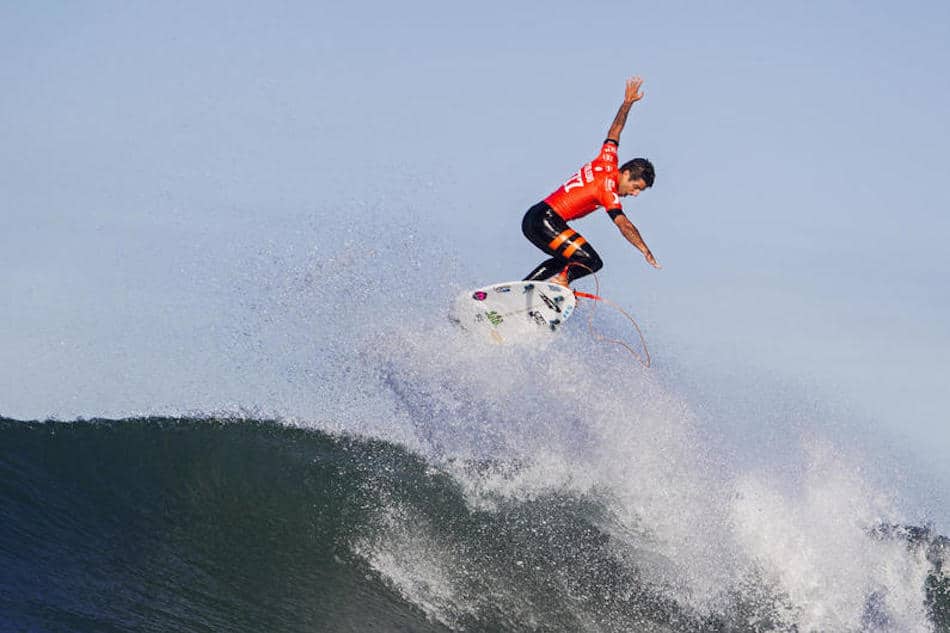

What a final day of surfing at the Rip Curl Pro Portugal! Wait, did you not watch?
This is the Age of Conspiracy Theory. Events accelerate away from human understanding, as they did in Portugal, and we seek the surety of an unseen hand in the narrative. Wouldn’t you, if the WSL was a quisling under your command, seek the drama of a mad Pipe showdown and engineer, any way you could, results to favour that outcome? That’s what Kelly thought when Fanning was denied the chance to clinch the Title on Portugese shores by a local wildcard and thus make Pipe a dead rubber.
The wildcard keeps the locals on the beach, grows the sport locally and the showdown moves to Pipe. Here’s another, shocking, giblet of conspiracy theory to chew on as we digest both the Portugese result and the much bigger implications for Pro surfing and world sport.
“My Doctor thinks I’m a parasite.” That’s not some horrific nightmare visited upon me after twelve days of relentless late night nightmare close-outs but an actual newspaper headline. You can read it here. The translation from Portugese super journalist Sara Sanz Pinto concerns none other than Robert Kelly Slater who dropped the bombshell that he may have parasites that are affecting his testosterone production. Doesn’t that explain everything? Really and truly. The weird little flame outs and flat spots. The slow decline down the ratings. Frantic emails to both Sara and King Kelly for clarification on the parasite issue have gone unanswered at time of writing. It does provide some comfort for fans struggling to come to terms with the fact that for the first time, well ever since he came on Tour, Slater is going into Pipe with zero chance of winning the Title. All because of a little fucking bug freeloading off his testosterone. What an ignominious end to the Age of Slater.
Pro surfing abhors a fairytale: normally the house wins, the little man gets his dream crushed. Not this time. I would have bet the house I don’t own on Medina winning both his QF against Ferreira and the whole comp. It looked destined, baked in to the theory. Medina had him comboed after 5 minutes with a pair of sixes. The sound of dogs barking came through the webby, a clear sign. But of what? Italo speared a hollow left in the throat then dissected a right to throw the combo right back at Medina. He finished Medina off with a wild tail high spin into the onshore. Somehow I’d written off Italo based on a dim view of the Aus and American rookie talent. Bad call. Italo personifies the current reality of catastrophic victory for the Brazilian storm. They’ve stormed the citadel and found nothing there except aging stars and a few straggling journeymen; their western peers constructing Instagram careers well out of harms way.
Lets zoom out and widen the frame. Nostalgia is a bitch teat I try not to suckle on too often but five years ago to the week, Nov 2010 was the great turning point in modern professional surfing. It was the last week alive for Andy Irons, the height of Dane, Slater about to ice Title Ten. On the shore of Puerto Rico the sport was delicately poised. It had enlarged it’s conceptions to accommodate Dane; artistic and jock elements had reached an unlikely equilibrium. What we were seeing live was the true state of the art. It could have gone either way. The companies crumbled and ZoSea pounced with a total jock vision; once more the old whore would get a fresh coat of makeup and be wheeled out to middle America to face rejection, yet again. The last best hope for Pro surfing to become a performance art collective, something like seeing the best musicians at their peak live, was lost. When AI died the music died with him.
Doesn’t the current status of JJF prove that point? While we watch him sit and wait, neuteured by format and sub-par surf a trailer was released showing him at full potential. The fact the sport can’t extract and showcase pinnacle performances from Dane and JJF is the ultimate rebuttal to Speakers NFL vision for surfing.
The Final was the direct result of the WSL/Speaker model. They created a sport and seeing a dissipated American response and an aging or overrated Australian hierarchy the latinos simply reached up and picked the low hanging fruit on offer. There was no bipolarity in their thinking, no hesitation in the action. Hence two twenty year old Brazilians fighting it out in the Final in scrappy beachbreak. No conspiracy theory needed.
Did you watch the Final? Or did you boycott because it was two Brazilians? An existential question for the WSL. 7 am Hawaii, 10am LA, 1pm NYC, 4am Sydney. Judging waves is nothing like an objective science, more a voodoo mix of emotion and groupthink and the effect of the unseen hand but you’d be a cold fish in a wet sock if you didn’t give Toledo’s opening wave a Ten. Ferreira lofted high into the golden heavens and was robbed of a ten for the biggest air of the year, or ever. Toldeo kept boosting, Ferreira refused to submit. It was the best Final of the Year, the first time a dominant performance hadn’t seen an opponent buckle. By the time it was ended the high water mark of Dane, of Slater had been washed away. If you missed it, you blew it.
Should Portugal be iced? No. It’s the perfect litmus for where the sport is at. Portugal makes sense, Portugal is the future. The dogs have stopped barking and the caravan rolls onto Pipe, last chance for aging heroes to exit with dignity intact.

Commented on Disqus? Log out, tap the Disqus button, and your old name and comments come back. The box is ours.
Your comments are still here. Every one of them.
Twelve years of BeachGrit comments came across from Disqus. Connect and we will show you how many are yours. We get your username, nothing else.
Connect Disqus to reveal.
Yeah I hear you… I think “professional surfing” may be the problem itself. Must be some way of getting cutting edge performance surfing in the best waves to the forefront, then hopefully the bullshit will fall to one side.
Whats the alternative?
So Slater now has a “parasite” that is fucking with his testosterone, cant digest food and he is losing heats and cant win a comp, and he is getting tested by doctors, machines, and even making his girl get tested? How about this: you are 43 my friend and you are competing with 20 year olds, get over it, you’ve had a veeeeery nice long run
Hi, Longtom, you shouldn’t trust in Google Translate. Here is what I wrote:
Kelly told me that after France he went to London to see an osteopath that studies natural
medicine. He has some machines that can actually tell what is happening inside of our bodies. His girlfriend got also tested. This doctor thinks he has parasite, which is living inside of his body for a long time, and that is affecting the way his body produces testosterone, digests food, and other functions.
He will have to do a bunch of tests to discover which kind of parasite exactly is and after that he will be cured with herbs.
Thanks Sara, I took a chance that the readers would see the comedy in the obviously very incorrect translation, but seriously, thanks for the awesome, as always, reporting.
whether or not the translation was correct, fuck is wrong with Slater if he’s visiting an English Osteopath who’s telling him he has a parasite impacting his testosterone production?
Where can I buy one of these Slater parasites please?
“By the time it was ended the high water mark of Dane, of Slater had been washed away. If you missed it, you blew it.”
You know you aced it when people quote you. Totally agree and I’m glad I stayed awake to witness such a dumbfounding final. It was horrible and beautiful at the same time, I’m never in awe before imperfection, but imperfection, even ugliness brought about brilliance.
I might end up unconditionally in love with competitive surfing after all.
“The doctor thinks I’m a parasite” is a seriously incompetent translation, it reads “The doctor thinks I’ve got a parasite”…
But then again I’m probably being naive in thinking it was a mere lapsus linguae.
Italo is a beast, but the real story of the day is that CHAZZ MICHAEL MICHAELS joined Beachgrits fantasy surfer club. First time player, gets 9th in the world!
haha this contest actually favored those who were bad at/new to fantasy.. anyone doing well was clearly going to have as many top 10 guys as possible, only 4 of whom made it past round three. also don’t try to downplay my domination of the league!
I had Filipe and Italo. Unfortunately, also had JJF and Julian.
but at least JJ is a shoe-in for a big result at pipe (thought everyone ever, but will doubtfully come to fruition)
Amongst the crap: “What an ignominious end to the Age of Slater” was a gem. In other words, Kelly was hallucinating when he shouted that Mick won his heat. Mick lost, fair & square.
Slater has to be the poorest loser in the history of professional surfing.
In his post heat interview, he had the audacity to say that they shouldn’t have run the heat he lost to Italo at cloudbreak… it was pumping! owen got two 10s about a half hour after slater’s heat
Right? Don’t know if the decline of his career, the age…who knows? But the guy have totally lost his composure. Saying shit to Mick after his heat (Mick was clearly embarrassed) or giving shit to Simpo, saying his seating on him like a brazilian…wtf Slater!?
Still the best of all time. And i’m still grateful of what he has done to the sport…but man, Slater is acting like a kook and a sore loser.
To be fair he’s alway been a sore loser, and losing is a hard pill to swallow when you have spent your whole life winning heats.
Why do we expect pro athletes to be good losers anyway? Slater’s a dick and that’s what’s always given him his edge.
I agree that we expect a lot from professional athletes. BUT Slater comes across a bit of a hypocrite. When he was winning he was Mr. Nice. Always preaching how you have to be a good sport. Now his loosing his acting like an a-hole. Very easy to be Mr. Nice when you are on top. Also, pp say a lot of shit about Medina been a sore loser but I never hear a comment like yours when comes to Medina. Not saying that Medina doesn’t needs to have better manners (he does) but pp have to start see things as they are, and the thing is Slater the last couple of years have been acting like a fool.
I like sore losers, A tour full of Micks would be very dull instead. Toys being thrown out of the cot is far more entertaining… I think Slater’s freak factor may have more to do with his world titles than him being a dick.
Agreed. But as I said below Slater comes across a bit of a hypocrite. He really worked hard to have this impeccable image of Mr. Nice guy….easy when you are always winning. Now he even shows some prejudice, like saying how aggressive brazilians are in the water. When he was Medinas age he was the same shit in the water (anyone forgot Slater snaking Beschen?). And bitches all the time: about hassling, wave conditions, scores… kind of a let down.
The human brain loves predictability and order, which is why we have hypocrites. Unfortunately, we’re all hypocrites now and then. Slater’s no better than the rest of us, other than in the water.
And that´s why i admire Slater for his surfing and only that.
Yap, still butthurt from losing to Frederico last year so he was poking Mick who is in a total different league when it comes to sportsmanship… different colonies I guess.
Let’s be clear here – AI was not, in any way, shape or form, part of any exciting surf world in the days before he died. He was a has-been and we all knew it. And that Dane and JJF can’t do in comps what they do in free surfs isn’t an indictment of the WSL, it’s an indictment of them. In fact, watch JJF lose to Gabs heat after heat, in pumping Chopes or small Trestles and you’ll see that the issue isn’t the system, it’s the soft white kids in it.
Can’t disagree with that analysis. I guess the point is 2010 with Dane and Slater still at a peak and JJF and Medina about to come on strong and ZoSEa getting the ASP for free was THE golden moment to rejig the whole thing root and branch and drop the dead model they have been carrying around their neck like a carcass.
The death of AI at that time just seems like a strangely symbolic motif of that lost opportunity.
It’s a lot easier if you just take pro surfing for what it is. After several decades, we should all understand it’s a flawed, and largely unpopular spectacle. It will remain that way unless/until wave pools take over the world.
well, thats true too. My defence is Pro surfing is just something humans do, like warfare, sex, shopping, agriculture, music etc etc.
I can’t really help thinking about it and writing about it, even though life would be easier if I could.
I still think it’ll be flawed and unpopular when wave pools take over, and I’ll still be thinking and writing about it.
Man, you´re 100% right!
Interesting to see young Brazilians winning contests and world titles and the young aussies/seppos no where to be seen , except our aging stars and struggling journeymen, are a product of the NEW surfing bureaucracy , how long before they are all sacked and it becomes performance based and not commercially driven??
“They’ve stormed the citadel and found nothing there except aging stars and a few straggling journeymen; their western peers constructing Instagram careers well out of harms way.”
………best sentence i’ve read yet concerning the state of the tour.
was also going to share this in the comments. couldn’t agree more
I’d like it to be known that this sentence has now officially been used in a uni research paper #academia
really? In what capacity?
I wrote a paper on the current status of surf culture in america, australia, and brazil and the historical socioeconomic frameworks that have laid the foundation for our modern surfing world
whoa, sounds interesting, possible to read a copy?
FOREWARNING: long read (2,600 words). this paper was supposed to be the product of a semester-long journey of intensive research, analysis, writing and rewriting. Instead, the entire concept, all the research, planning, and writing was performed within a 24 hour period, in which I utilized a bullshitting method that has been nearly perfected through 3 years of trial and error. There are some things in this paper that are entirely untrue, I couldn’t be fucked to verify half of my claims. The person grading this paper knows as much about surfing as Chelsea Cannel, so it will most likely get through undetected. Try not to focus on small details, ignore the cliches, and think BIG PICTURE. Also don’t be too harsh… I’m aware this reads like it’s written by 10th grader, but marks don’t count when you study abroad so who gives a shit! without further adieu…
(sorry it copy pasted in this shitty format)
In this paper, it is
argued that socioeconomic factors have determined the way in which surfing is
perceived and performed across the globe. The research was focused on three of
the most prominent global surf cultures – the United States (which will also be
referred to simply as ‘America’), Australia and Brazil. Due to economic
prosperity during surfing’s formative years, America and Australia were able to
partake in recreational activities such as wave riding, while the majority of
the Brazilian population was too focused on financial survival to spend their
time on such whimsical activities. In America and Australia, surfing became a
hobby, a profession, and a way of life. In Brazil, surfing was viewed simply as
a pastime and was not generally endorsed by the media or the state. However
times have changed, and Brazil’s major economic upswing over the past decade has
coincided with the biggest surfing revolution in the sport’s history, commonly
known as the Brazilian Storm (Barbassa, 2015). This
essay will detail both the past and present states of surf culture across these
countries, and it will distinguish the socioeconomic factors behind them.
A
simple glance at today’s global surf culture would not suffice to make sense of
why certain countries perceive surfing differently from one another. It thus
requires insight into the beginning of modern-day surf culture, when it was
first brought to the continental U.S. by
Hawaiian surfing legend Duke Kahanamoku. In 1920, Kahanamoku met a young
man named Tom Blake, and this connection would be the catalyst to surf culture
as we know it today. Blake would learn about surfing from Kahanamoku and
consequently fall in love with the sport. About a decade later, Blake would
establish and win the first known surfing competition in Corona Del Mar, California
(Warshaw, n.d.). This was the beginning of not just a newfound American sport,
but also a lifestyle that would become synonymous with the Sunshine State (Ormrod
39). Almost a century later, the entire Californian coastline is littered with
surfers- some young, some old, some boys, some girls, some like big waves, some
like small, some ride short boards, some ride long, some compete for sport,
some see it purely as an art (Moriarty 10). Despite their many differences,
American surfers all feel a common bond that centers around the ocean and the
act of riding waves- one scholar even went so far as to call it an ‘aquatic
nature religion’ (Taylor 930). Despite what anybody says, surfing is more than
just an activity; it is a way of life.
Surfers on the
east coast of the United States are often considered to be even more diehard
than their western compatriots, as they consistently subject themselves to
atrocious weather conditions in pursuit of typically poor surf. They consider
themselves to be “core” surfers, due to their high level of commitment to the
sport even in the most appalling conditions (Flynn 399) This past winter, the
temperatures in the Northeast were so low, that parts of the ocean started to
freeze. Surfers were documented riding waves in the slushee-like conditions,
dodging the odd iceberg as to not ding their precious surfboards (Sager, 2015).
This type of dedication speaks volumes to the love and attachment that surfers
have for their trade. Most who grow up
surfing do not succeed in turning professional, but most will end up getting a
job in the surf industry, or at the very least they will hold a position with
enough flexibility to be able to play hooky when an epic swell does arrive.
Surfing becomes an addiction for many, as the fear of missing a pumping day of
waves eats at them from the inside to the point of near-depression. As a
result, they structure their lives in a way that allows them to get their
aquatic fix on a regular basis (Callaway, 2015). Although there are many
landlocked Americans who know nothing of the sport, those who are part of the
surfing community allow it to seep into every facet of their lives.
Australian
surfing culture is similar to the American example in many ways. Although
surfing was introduced to Australia shortly after Kahanamoku brought it to the
United States, Australians were quick to catch up to and even surpass their
American rivals. By the time that professional surfing had been legitimized
with a world tour in 1964, Australian surfers were considered to be the best in
the world, which was proven when Midget Farrelly won the first-ever World Title
that very year (World Champions of Surfing, 2009). Australians made up the
majority of the world champions up through the mid-1990s, until an American phenom
named Kelly Slater came in and flipped professional surfing on its head.
Winning five world titles in six years and 11 (and counting) in his lifetime,
Slater is considered by many to be the greatest surfer of all time. However,
Australia still retains the honor of the winningest country in the history of
professional surfing (World Champions of Surfing, 2009). This is due to the
fact that Australians love surfing just as much as Americans, albeit in a more
specialized way. Australians were the first to make surfing a truly
professional endeavor, with focused diet and exercise programs that were geared
solely towards performing well in the ocean. This jock-style surfing regiment
remains prevalent in today’s Australian surfing culture. Establishments like
Hurley Surfing Australia High Performance Center (or HPC) are designed to take
young surfers and turn them into competitive-minded ocean warriors. By
utilizing well-experienced coaches, a top-of-the-line training facility, and
extensive video analysis, the HPC is trying to cultivate Australian world
champs for decades to come (Hurley Surfing Australia High Performance Center,
2015).
While this
competition-driven mindset makes up a good portion of Australian surf culture,
it would be foolish to dismiss the many individuals that see surf as an art
form, or a route to freedom and self-expression. Arguably the main catalyst of
this modern-day movement is the dynamic duo of Dion Agius and Kai Neville— Agius
being the eccentric surf star and Neville the uber-talented filmmaker.
Together, and with the help of other talented surfers and filmmakers from
around the globe, the pair of Aussies have gone on to create some of the movies
that define the current youth surfing generation. Classics such as Modern Collective changed the way that
young kids saw progressive surfing, and it made the sport into more than just a
competitive formula, but also a forum to express one’s personal kink and flair
(Modern Collective 2015). It is not uncommon for a young Australian to divert
from the competition lifestyle and take the path of a professional “free
surfer”- one who is endorsed by companies to travel the globe, get filmed
surfing in exotic locations, and sell the beautiful lifestyle that is surfing.
Many of these surfers feel a strong contempt towards the competitive side of
surfing, because they believe that it is stripping the sport of its
individuality and uniqueness. 19 year old Noa Deane, already a high-profile
Australian freesurfer, infamously shouted, “F**k the WSL (the governing body of
professional competitive surfing)!”
whilst receiving a prize at the coveted Surfer Poll Awards (Deane 2015). This
incident caused a litany of issues within the surf world and seemed to create a
rift between free surfers and competitive surfers.
Surf
culture in Brazil is markedly opposed to that of America and Australia. Up
until the 21st century, surfing was not an accepted professional
endeavor within Brazil. The large nation certainly had its fair share of
surfers, and without a doubt they experienced the same thrill and joy from
surfing that was felt by Americans, Australians, and the rest of the world
over. However, surfing was rarely seen in mainstream media, nor anywhere else
outside of coastal communities. Small enclaves of Brazilians extensively
followed professional surf culture, but it was more cosmopolitanism then it was
indigenization (Adams 2007), so to say that Brazil had a surf culture of their
own would be a stretch. While companies in America and Australia promoted the surfing
image due to its “cool” and “worldly” appeal, the Brazilian media focused on
soccer as its main sporting enterprise (Fusion 2014). Soccer had always been
Brazil’s great equalizer- the one thing that brought together the rich and the
poor, the black and the white, the young and the old. Little did they know that
this was all going change in the near future.
As of 2014,
surfing has become Brazil’s #2 sport, right behind their beloved futbol. This
innocuous oceanic activity has taken the country by storm, and many people
wonder why. The New York Times has argued that the surf culture disparity
between America/Australia and Brazil was due mostly to economic forces. The
Brazilian financial downfall of the 1980s and ‘90s left the country unstable
and essentially unable to support the fad-like cultural phenomenon that was
starting to grow in coastal areas (Barbassa 2015). The evolution of the sport
was severely hindered because the Brazilian people lacked expendable income, and
the media was not promoting surfing like they were in the Western media
outlets.
Alas,
the 21st century has completely undone everything previously known
about Brazilian surf culture. Brazilian professional surfers are no longer just
a novelty, by any means. In the 1990s and even the early 2000s, there wereusually
a handful of Brazilians that would make the world tour, but they would
generally flounder around in the lower ranks until their inevitable fall from
grace (Barbassa 2015). However, today is a different story— 2014 marked the
biggest moment in Brazilian surf history. Gabriel Medina, a 20-year-old
wonderkid from Sao Paulo, became Brazil’s first surfing world champion by
decimating his competition in true alpha dog-fashion (Warshaw, 2015). After
Brazil’s national soccer team had a disparaging flame-out in the World Cup, the
Brazilian media shifted all focus towards their one hope of sporting salvation—
Mr. Medina. The entire country rallied behind the Brazilian superstar as he
went into the last and most important competition of the year, the Pipeline
Masters. Medina needed at least a 3rd place finish to ensure the
World Title— he got 2nd. With Gabriel as their new national hero
and surfing as the new “it” thing, Brazil was reinvented on that December day.
This year, with just one contest (the Pipeline Masters) remaining in the World
Title race, 4 of the top 6 surfers in the world are Brazilian (the other two
are Australian), all of whom have a shot at taking home surfing’s biggest prize
(World Surf League 2015). As a result of the professional surfing boom in
Brazil, the rest of the country wants to feel part of the surfing community.
This has led to more surf interest amongst the Brazilian populace, more
purchasing of surf-related goods and apparel, and more Brazilian surfers as a
whole.
When
the Brazilian economy started to improve in the early 2000s, Gabriel Medina was
just a child. He surfed for the first time in 2002, at the age of 9. By 13, he
had his first sponsor contract, by 15 he won his first major professional contest,
and by 17 he had qualified for the world tour (Warshaw, 2015). His rise, along
with the rise of the many young Brazilians that share this journey (all
Brazilians on the world tour are between the ages of 20 and 27, meaning they
grew up in the precise time period that the economic boom occurred), are
products of a socioeconomic phenomenon that has altered both Brazil’s culture and surf culture. As stated in the New
York Times, “This is
good for Brazil, but it is also good for the insular, overwhelmingly white
world of professional surfing; Brazilian surfing has brought black faces into
the sport’s elite circles” (Barbassa 2015). However, many Western surf fans
quietly dispute this change in the guard. Many Americans and Australians are
visibly upset by the newfound Brazilian domination, as can be seen in the
comment sections of any surf-related website or at the local surf club. Some
speculate the anger is racially motivated, while others claim xenophobia, and a
few even call it self-preservation, because if the current rate of replacement
were to continue, there would be no white surfers on the world tour within 10
years.
The current Brazilian
domination was best summarized by surf journalist Longtom, who wrote, “Italo [Ferreria (rookie on
the world tour and one of the four Brazilians who is currently in contention
for the World Title)] personifies the current reality of catastrophic victory
for the Brazilian Storm . They’ve stormed the citadel and found nothing there
except aging stars and a few straggling journeymen; their Western peers
constructing Instagram careers well out of harms way” (Longtom). The author is
implying that first of all, Brazil has completely taken over the professional
surfing world, with no end in sight. Meanwhile, the Americans and Australians
are left twiddling their thumbs, wondering what they can do to thwart this coup.
This reaction is no surprise, as it can also be explained through a
socioeconomic lens. During the time of Brazil’s economic despair, Australian
and American economies were relatively well off (United States Department of
Labor 2015, Mygreenlife 2015), which allowed them the
luxury of pursuing novelties such as surfing. Through this, surfing became an
actual culture within these privileged nations, and an industry was built
around it. Naturally, these two countries dominated the sport based around the
culture that they had created. However, when a country such as Brazil, that
knows true hardship, is finally given a chance to succeed, they are going to
take that and run with it. While Brazilian surfers are putting in 10 hour days-
training, surfing, and eating right, their Western rivals are coasting on the
triumphs of their privileged predecessors. Even Australia’s competitive drive
has waned, for only one 35 year old veteran, Mick Fanning, appears to be up to
the mental and physical challenge of fighting off the Brazilian Storm.
There is no passion that
burns as deep as necessity. Brazilian surfers are often unsponsored and
unrecognized, even if they are twice as good as their Australian and American
competition. In the Western world, a surfer can have a multimillion dollar
contract simply by forgeoing competition altogether and portraying a “cool”
image (Congdon 52). As a Brazilian surfer, it is possible to be on the world
tour and be completely sponsorless, as was Raoni Monteiro for most of his
career. This makes their will to win increase tenfold, because it is not just
about pride for these Brazilian surfers, it is often the desire to put food on
the table that pushes them to such heights. Moreover, it all boils down to
this: Americans and Australians have always had the luxury to be surfers,
whereas Brazilians have not. Because Brazilians have a newfound economic
freedom to pursue ends such as surfing, they want it twice as bad and are
willing to work twice as hard as the Americans and Australians. To Brazilians,
surf culture is not about looking “cool” or portraying an image of nonchalance
or indifference. They are simply happy to perform such a pleasurable activity in
the form of an occupation, and therefore they work without rest to maintain
their position at the top. Meanwhile, the Westerners are beginning to realize
that they can no longer glide along and get a free ride on the backs of their
Instagram followers. If they want their careers to stretch into the future,
they will have to put down the phone and get to work. Until that happens, until
the Americans and Australians truly want it as badly as the Brazilians do (and
excluding another debilitating economic downturn), the Brazilian Storm will
surge on, annihilating every Anglo wave-dancer in its path. This means that in
order to succeed, Americans and Australians will have to alter the very surf
cultures that have dictated their lives for nearly a century.
Sorry Mate just noticed this in the spam box… I think it went there because of the size {phew!}
professor’s orders!
Post it up for us in the peanut gallery…
Well goddamn Thomas, that was one hell of a piece of writing.