


Two weeks to build, comes in big box, stick it on lake or river!
Want a portable wave tank? Twenty-five metres long, thirteen wide? Drag it anywhere, takes two weeks to assemble (the parts come in a container), use river water, lake water whatever and it costs something like a hundred bucks a day in electricity to run?
Zero water consumption, low power bills?
Now that sounds like a biz that works.
Lately, you might’ve got the feeling that wave pools are the new arms race.
It’s the Slater-Finchim tank vs Webber vs American Wave Machines vs Wavegarden vs Surf Lakes and so on. Each pool slightly different, each with its own imitation of ol’ ma nature.
Who’ll win? Who’ll be dashed upon the rocks of insolvency? Will all of ’em prove to be monstrous white elephants, destined to become creepy concrete pits when the surfers don’t come?
A slightly different angle on the game are the German companies, City Wave and Unit Park Tech. The Germans are into the standing wave model, the sort pioneered by the American Tom Lochtefeld and his Flowrider. Tom’s been in the game since the eighties, opening that first Flowrider in Texas in 1991. He knows the central problem to wavepools. They cost too much to build, and way too much to run.
And the Germans, who usually get their first taste of surf riding stationary river waves, aren’t adverse to the idea of this kinda tank.
The Unit Surf Pool, by Unit Park Tech, is, according to the PR, “a floating surf pool construction that brings a surfable deepwater wave to any body of standing water… it operates on a natural body of water which translates to an endless water supply and no need for chemical water treatment.
It’s a good sell.
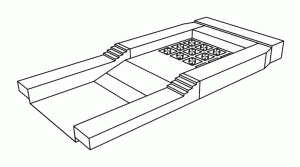
The first commercial version is at a joint called Surf Langenfeld between Dusseldorf and Cologne where the Unit Park Tech HQ is (history lesson: Cologne was one of the heaviest bombed cities in World War II, almost the entire population evaporated or evacuated).
Now, you’re not going to detour to Germany to jump on the damn thing, in case you’re wondering it’s 34 Euro an hour to ride, but it does show there’s a quick-to-build, cheap alternative to the magnificent $20 million-plus structures being shopped around.
Watch here.
Commented on Disqus? Log out, tap the Disqus button, and your old name and comments come back. The box is ours.
Your comments are still here. Every one of them.
Twelve years of BeachGrit comments came across from Disqus. Connect and we will show you how many are yours. We get your username, nothing else.
Connect Disqus to reveal.
I actually feel like I read something new in this article. Feels good
You forgot about Negs. He knows all.
Derek let me boil down this article for ya. Save you some time clattering your keyboard next time: Click this link here for a wave will make you a pro at stiff, retarded looking cutbacks on a waist high mushy wave created by propellers; much like a boat wake.
While my absolute favorite potential benefit of this tank, the “drink a beer while you wait your turn” model is a proven non-revenue producer.
See: every public skatepark anywhere in the world.
Ever skated drunk? Proper drunk? Fuck it hurts.
Not in a long time. Skating soberish hurts enough if I’m slamming or trying something new (which means I’m slamming).
The beers are better channeled towards my disappointment in aging and the difficulty of maintaining a relative skill level.
I’m with you!
I’m going to track Slater’s movements via Instagram, and then check every single IP address on here until I find a match!
Way more enjoyable than going out into the cold, scary post-antibiotic ocean.
I know! muthafucken SD. Kelly loves us!
https://uploads.disquscdn.c…
Green and free or muddied with greed
or how many surfers could bend that low for that long on the left , and ah on the right we have a stand up barrel, for those of us who like waves over 1/2 a head high, unless you are Tom carrol which makes it head high!
As a tall green water loving goofy who refuses to go in lakes for whatever reasons I had no choice but to choose nature’s left over the right hander next to the train .Any ideas of what you might ride or shape for yourself or others who were leaving the ocean to surf at the ranch ?Lots of talk about business but little talk of performance and design.
Now if only they could workout how to put it inside and heat it because it’s a lovely 3degrees and raining 🌧 today in the German Republic , while the rest of the family is enjoying a thumping SE swell (free of charge but no shortage of chargers) somewhere between Nowra and Ulladulla in the middle of summer .
I like that it is called the “unit” for some reason
https://78.media.tumblr.com…
Cologne is also home to some of the most delectable teutonic maidens god ever set breath into.
Exhibit A! https://uploads.disquscdn.c…
Just imagine them nude on the beaches of south west France 🇫🇷 🇩🇪 and any thoughts of paying 34€ to surf a frozen lake can be thrown out the window .Lovely Images of the heatwave during the 2006 World Cup in Germany.
yeah but comparing German women to French women , not even in the same ball park , in fact I would go as far as to say , that French women are Numero ono !
After a handful of long term relationships with , comme on dit en France plusieurs très belles femmes françaises,over a period of 20 years ,I fell for and married a wonderful German woman . Go figure .It definitely wasn’t for the waves , the climate or some dodgy static man made wave on a frozen lake .
perfect , as I once said to my son, if you want to play and be entertained sexually , French women are the best , but just don’t marry one as Australians are too macho for them and they love the control!!
Yes, but the Germans are into far more kinky, deviant sex acts. That whole leather and BDSM thing has roots in the eastern Germanic, western Slavic area I think.
yes those big Blonde buxomous Frauleins will take care of you , if you are obedient!
Germans are vastly underrated.
Plus they are into leather and kinky shit. Win win situation. I think we have found a new Mecca!
and a magnificent cathedral, possibly dedicated to their beauty and an ok football team FC Köln
Not just Cologne, all over the joint. Leaving on Monday after 3 yrs, back to the South Coast – where god was more wave-focused than maidens.
Yeti Wavebox?
I’m actually for wave pools now. Anything to clear lineups in the ocean is fine with me.
Are you related to Strider’s Attack Dog Tits? https://uploads.disquscdn.c…
Those are just mine.
Juice or push ups?
gotta be a blend.
Nipples like industrial thumbtacks! It ain’t nature!
The power of the click! So appropriate on MLK Day!
Invest in Surf Lakes here! https://www.surf-lakes.com….
Have the gods gone crazy? Are we to believe that the world is flat?
SLATER DESIGNS advertising on Beach Grit!!!! Holy Shit Fuck!
Who can deny the magic of micro-engagement?
Well ya just lost Pete Schroff as a reader
And Volland.
Did Sean hock his computer? Those energetic fingers sure have been quiet. Did a Slater fan strike? http://beachgrit.com/2017/0…
I’d back him against a Slater fan. You know, one of those golf playing, chia seed munching 35-45 year old kooks.
Petey is bolted on, ain’t ya boy!
https://uploads.disquscdn.c…
God damn! that banner ad looks amazing… Has Slater finally found his home?
Just a glimmer of nymphet flesh! Sexy!
micro-enragement?
I read that as “who can deny the magic of micro-aggression”
At least they will pay in cash, not boards
baht
I guess McCintosh has no juice with the goat.
Somehow they need to market wavepools so that the biggest fuck sticks in the ocean (think Laird types) feel the need to use them frequently. Any ideas?
Yoga-foiled SUP-pool
With Laird SuperFood products available.
I bet the marine life would love get up in one of those pumps! Dinner’s sourced while you’re sliding on a predictable and efficient German-built wall.
Edit: Scrap that, actually has been awarded a *FISH FRIENDLY CERTIFICATE so there will be no fishy casualties
#PlayingTheFishCard
what is so god damn wrong with ocean waves?
It’s just so hard to make money from a free resource! Business people hate the fucking ocean. Useless, no good, piece of crap.
What’s so wrong with drinking water from a tap?
Fluoride gives you bitch tits!
Hahaha. That’s the best fluoride conspiracy theory I’ve heard. What if there’s fluoride in the wave pool water?
Magazine covers! https://uploads.disquscdn.c…
And white teeth which will get you more sex than tattoos ever will . ( at least if your over the age of 30 )
Too many shitheads in the way!! Surfed two days ago with 100 kooks and rippers and only 80000 people live here. We need multiple slater wave pools at every marquee destination in the world. With all the billionaires that live on kauai and the number of surfers and people shitting out more babies, we deserve at least 5 here. Someone direct mark zuckerberg to this post!!
Too far from the Fatherland, and seawater also touches shithole countries. Better to play it safe at your friendly neighborhood Alpensee!
Ain’t too many of ’em in Dusseldorf…
True that, I just have wave pool (technology) fatigue. Need to ride one asap.
You’ll be surprised, pleasantly and unpleasantly.
That NDA is on the brink… c’mon spill!!
It’s seeping out! https://uploads.disquscdn.c… https://uploads.disquscdn.c…
What’s that little pink number you trotted out for the occasion then, Derek? Did you swither and ache over the decision?
Hybrid Spray . 70s lightning bolts clashing with 80s new wave inspired checkerboard over a fluoro pink background. Interesting ?
I would never have thought Nick Carroll would become a ventriloquist dummy after a long day on the ranch and if it was any one else I‘d be asking where Queen Sophie‘s Hand might be .
fills out a sweater nicely too for being on the better side of 50. There’s some quality genes in the Carrolls’ pool.
Also, surf writers: middle age white men who look like Peter Pan Syndrome. Who knew? Oh yeah everybody
I think a lot of people may see him as Tom‘s writer brother but he was a great competitor winning 3 Australian Titles and a poster boy for Piping Hot and Hot Buttered in the 80s before Tracks and then Surfing . Obviously he never stopped and turned into a bag of walnuts and not a balloon like those who have .I not sure about Peter Pan and I ain’t no surf writer but I definitely hung out with the Lost boys long into my 40s .
like pink eye?
What did you ask Santa for, Nick?
0nly 11.75% of the people in this photo are women. Seems, fair?
Yes but , one half of this 11.75 % is the CEO 👩💼 of the WSL and a woman . Possibly the glass ceiling is lower in surf journalism than in business . Buggered if I know .
dick in a box.