



A money-makin' machine!
What wild days these are. Hollywood actors on strike and/or getting pelted by ex-girlfriends via Instagram Stories, unprecedented heat blanketing the planet, American students instantly debt free and Uncle Joe has a potty mouth. So much crazy that the concept of artificial waves breaking on demand seems normal.
But do you recall the shock when surf great Kelly Slater debuted his Surf Ranch facility for the first time? Watching that green mirage peeling out of the mist? Well it was enough to make everyone collectively forget that the brave Brazilian Adriano de Souza had won professional surfing’s crown forever.
Though did you ever wonder how much earth-saving energy it actually takes to power each wave? Well, now we know. Wired Magazine, using Surf Ranch’s patented plow technology, has come up with the exact formula.
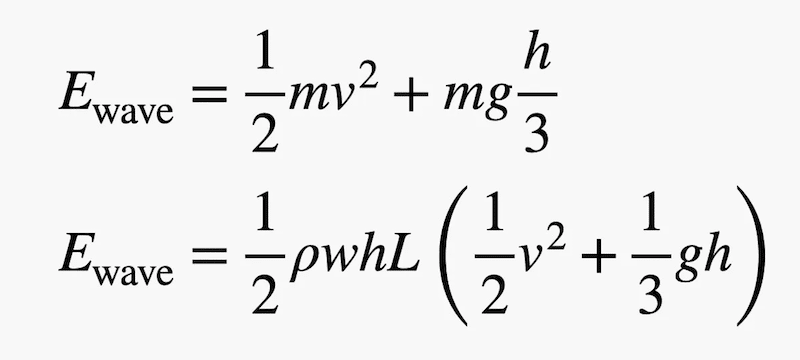
Very cool but what does it all mean?
According to Wired:
OK, now that we know the energy it takes to make a wave, we have some options for how to create this thing. Suppose you use an electric motor to pull the hydrofoil. If the motor is 85 percent efficient, then you will actually need to put 19 million joules into it in order to get 16 million joules into the wave.
The average price of electricity in the US is 23 cents per kilowatt-hour. Power is a measure of how fast you use energy, and we can calculate that as P = E/ΔT, where T is time. If energy is in joules and time is in seconds, then the power would be in watts. So 1 kilowatt-hour is the energy you would get running 1,000 watts for 1 hour (3,600 seconds), or 3.6 million joules. That’s how much energy you get for just 23 cents. If you want 19 million joules, it would cost you $1.23.
What about a gasoline-powered hydrofoil? In the US, you normally buy gasoline by the gallon; in other parts of the world, it’s sold by the liter. Gasoline stores about 34 million joules per liter (or 128 million joules per gallon).
However, a gasoline engine has a much lower efficiency than an electric motor. At best, it would be 40 percent efficient. That means we would need to use 40.9 million joules, or 1.2 liters (0.32 gallons) of gasoline. Assuming you pay $3 per gallon (which is a bit lower than the US average in July 2023), that would cost close to $1, or about the same price as an electric-generated wave.
$1 per wave?
Let’s guess that Surf Ranch pushes out 8ish waves per hour for 8ish hours a day. That’s $64 dollars of unleaded gasoline. Renting at $70,000 per day, that leaves $69,936 of pure profit.
No wonder Dirk Ziff is a billionaire.
Commented on Disqus? Log out, tap the Disqus button, and your old name and comments come back. The box is ours.
Your comments are still here. Every one of them.
Twelve years of BeachGrit comments came across from Disqus. Connect and we will show you how many are yours. We get your username, nothing else.
Connect Disqus to reveal.
Is it really totally pure profit?
What about payroll and maintenance expenses?
What about the capital investment costs to design and build? What is/was the payback time period on initial investment?
CAPEX is probably in a 20 to 30 M$ range.
REVENUE “The cost per day ranges from $35,000 to $50,000. On a per wave basis, this cost ranges from to $290 to $415”.
OPEX
The maths from the Wired article is so over simplified (very bad journalism to publish such wrong data). An ocean swell with a height of 2.1 meters and a period of 12 seconds would generate approximately 1298 kilowatts per 50 meters of wave front.
Compared to 5.28 kW from the article…
So let’s go for 800kW (because wave is not always that height and that fast). With overall efficiency of 0.6 (from hydrofoil + mechanical train total conversion into wave power) = 1330 kW.
5h/day
Cost for petrol = 2285 liters × $1.50/liter = $3427.5
Cost for electricity = 6650 kWh × $0.10/kWh = $665
+ Water treatment, maintenance, staff, etc (another great journalism treat with “That’s $64 dollars of unleaded gasoline. Renting at $70,000 per day, that leaves $69,936 of pure profit.)
Total conservative OPEX/day assumption = 5 k$
If they do 100 days/year at 50 k$ revenue in the US , 25/(100*0.045) = 5.5 years !
In Dubai the demand (at such price) would probably go to 200 days/year + longer hours at scale = 2 or 3 years ROI. Smart business except for the pain of finding huge land with that much water, which makes it hard to replicate fast.
see chlorine calcs above!
cost of chlorine: 45.83M gallons, and calculating for current & free concentrations of 4.5 ppm and 30, respectively = 59,000 gallons @ $10.oo gallon…$585,220.00
not sure if that’s a day, a month, or a year.
Who gives a flying fig how much “gasoline” it takes
Illegal aliens work cheaper ,this is California after all
When they say eat the rich… who’s dick i have to eat to get an invite at wave ranch?
PS, I let Elo eat my dick, and it didn’t end well for both of us.
Simmer down cowboy, I know nothing and am just making a joke
Nah just smash into my rumours, is it tru ELo learnt his fondness for teens from TB , was sarge involved , was MP hiding behind the curtains was AI doing a Michel Hutchison in the background mmmm so many innuendos so little time.
Not bad considering gasoline is a low end by product of crude oil , i would love to understand how much oil it takes to make say all Tyler Wrights boards for just one season on tour , plus the oil required to generate the aviation fuel to get her to each event and promo trip for a sngle season. Can the eggheads run those numbers for us.
Lets do co2 emissions instead = KS pool (gasoline assumption) wins by a x17 ratio !
For the KS pool: Petrol needed/year (in liters) ≈ 457 000 liters = 1051.1 metric tons of CO2 emissions.
Based on Energy consumed = 1330 kW × 5 hours x 200 days
(the article is so wrong with their numbers, an ocean swell with a height of 2.1 meters and a period of 12 seconds would generate approximately 1298 kilowatts per 50 meters of wave front.)
Average pro surfer boards and trips per year = 62 tons of CO2
20 surfboards could have a carbon footprint of approximately 2000 kg CO2.
30 flights×2 tonnes CO2/flight=60 tonnes CO2
Tell that to Ben Gravey
High end golf prices.
Pebble beach= 5 hours of punishment
Wave at ranch- 1 second to 45 seconds
What is swimming behind old mate.. And wonder if that’s why he’s escaping onto the board!
You couldn’t even decimate a Scottish wasp nest for that
Cool more prize money for the challenger series surfers then
Ok great breakdown. Now how about the amount of water and purchasing price. Then water treatment and condition of water after discharge. How much water is displaced, not by big turns but by facility. Also how are neighbors and farms effected if at all by displacement. With aquifers filled does the ranch even impact amount of water stored? Are there any people dressed like clowns? These are what I’d like to know.
tried to tick off the cost of chlorine (see above). enormous!
“Kelly. Open up the gate. Got an eight-ball that Secret Service gave back to me.”
https://youtu.be/8npdeouY398
That Ranch train is so money I can’t believe Wesley Snipes hasn’t tried to steal it.
Or R. Kelly pee on it!
“Our Kelly”..
Was the payoff to Elo’s sexual abuse victim calculated into these costs?
Did Brodie Carr do those sums, they seem a little off!
A 69k profit day still writes some IRS away, (with his Atty’s.)
Talked to a Hawaiian guy who went to the ranch with 12 people. He said it was pretty fun, but not worth the 6’000 bucks it cost to get the waves. He said from now on its indo trips for way less with better waves.
Are you serious? A Hawaiian guy? Why not ask some landlocked officer workers who rarely get a chance to surf instead.
I’d rather surf Ben Gravy’s waves that Hobbs makes with the red truck.