

"The suffering leads nowhere, circles in on itself, feeds on itself. Drouyn’s transition only worsens his mental health, and anyone still watching at this point is just rubbernecking."
Peter Drouyn has many pages in Encyclopedia of Surfing. His place in surfing is credited, accounted for, saluted. So the plan was to let Drouyn be, EOS-wise.
My take is that for four decades now, more or less, Drouyn has been travelling on rough mental health terrain—to which his splashy gender transition in 2008 was all but incidental—and the fact that we are periodically invited by Peter himself to follow along is not in itself reason enough to keep watching.
What Drouyn needs, I think, what he has needed all this time, is for us to go away.
But three weeks ago the Australian and New Zealand Film Archive posted two beautifully restored Drouyn clips from Bob Evans’ 1968 film High on a Cool Wave (watch here and here) and I was again riveted, both reels, start to finish, by Peter’s surfing. Moreover, the Florida Surf Film Festival, this weekend, brought us the years-delayed American premier of The Life and Death of Westerly Windina, a full-length documentary on Drouyn, his place in surfing, and his long and harrowing 360-degree venture into gender identity.
As a FSFF board member I got a previewer screener to Life and Death, clicked away—and there I was, gawking like everyone else, back inside the Drouyn house of mirrors. Because so much of Drouyn’s life and career is slippery or contentious or otherwise hard to pin down, let’s start with what is knowable and provable.
Peter Drouyn was a surpassingly gifted surfer. Versatile, progressive, captivating, more flair than any 10 people combined—you could not take your eyes off him. From 1966 to 1972, he belonged in the World’s Best conversation; had there been a world tour in 1970 instead of a one-off world championship contest, Drouyn would have beat Nat Young to the crown with room to spare. He won Makaha and the Aussie Titles that year, was runner-up at the Duke, third in the World Championships, and fourth in the Smirnoff.
But never mind the results, watch those two Cool Wave clips again, and also know that Drouyn crossed the longboard-shortboard divide with style and power and panache fully intact, and that for another few years he continued to ride at the highest level in waves of every description. If nothing else, Life and Death is a reminder that Drouyn’s center stage spot in the surfing pantheon is deserved.
That said, we’ve never really been allowed to dwell on this remarkable achievement because Drouyn is always ready to pop and tell us that he was ripped off, done in by the media, the judges (“those five idiots on the beach”), his surfing peers, anybody and everybody, all conspiring against him out of jealousy or spite or whatever else came to mind. Drouyn used to push this idea with amazing freeform narcissism, including a 1997 Deep magazine interview where he compares himself to Christ, Spartacus, and Henri “Papillon” Charrièe.
In recent years he’s made the same point but with martyred soft-voiced resignation, and this is what we hear just a few minutes into Life and Death, which means the gorgeous surfing we see onscreen is already being shaped and fogged by grievance. This sense of injustice drives the first part of the film, in fact, and it is hard going—partly because there is some truth to what Peter says, and partly because it is so obviously not true. (I’m leaving aside the claim that Drouyn as a child was molested by the local priest; Life and Death mentions this and moves on and I’ll do the same, although it would seem to be a headwater event Drouyn’s mental health issues.)
Drouyn at his peak was overwhelmingly charismatic, funny and articulate, and young-Brando-level handsome. He was also full of himself, quick to anger, nearly impossible to get along with for any length of time. He put people off as much as he entertained and charmed them.
For that reason, Drouyn may have got less attention, less plaudits, less titles, than he otherwise would have.
But how much less, really?
Peter lost close heats to questionable judging—like every other marquee surfer throughout history. He for sure didn’t get as many surf mag covers as Nat Young. On the other hand, he was interviewed and profiled, well-sponsored, and featured in all the Aussie-made surf movies. Surf-media kingpin Bob Evans was so fascinated by Peter that in 1974 he made Drouyn and Friends, the original surfing biopic. It is very much true that Nat Young and Wayne Lynch and Bob McTavish took up more than their share of surf-world oxygen from the mid- ’60s to the early ’70s, and some of that oxygen rightfully belonged to Peter.
But he outlasted everybody in terms of keeping our attention as a progressive surfer. He was voted into the Australian Surfing Hall of Fame after Young and Lynch but before McTavish—and before Michael Peterson, Terry Fitz, Pam Burridge, on and on.
He was never ignored. Just the opposite. All things considered, Drouyn is among the most-talked-about, least-ignored surfers of all time.
But in Life and Death, Drouyn and the filmmakers are clearly hot for injustice. The biggest ripoff of all, we learn, is that Peter was rated #2 near the finish of the 1977 season (the same year he directed the Stubbies event at Burleigh and brought man-on-man surfing to the world tour), but was denied a start in the season-ending Duke contest, and thus missed his last and best chance at a world title.
Again, this is true and not-true.
Drouyn did not get a Duke invite because the CT at the time was a mess and the starting field for many events was picked not by ratings but by whatever banged-up method contest organizers chose. Peter hadn’t competed in Hawaii the previous few years; he therefore didn’t make the Duke cut.
But the point is moot.
The Duke was not the final contest of the year (two more followed) and even if Drouyn had been invited and won, he would not have taken the ’77 title off winner Shaun Tomson, not even close. This is not hidden information. The spreadsheets are out there.
Nevertheless, according to Life and Death, the Duke contest was the knock-out punch, the event that “took Peter’s heart and soul away,” and from there we slide into the second part of the the film, and there will be spoiler alerts below, so stop reading if Life and Death is on your streaming watchlist.
Like I said, the first part of the film is hard going. But it is a Sunday morning cartoon compared to what’s next—the failed careers (actor, lawyer), the dead-end jobs (car salesmen, surf instructor, cab driver), and half-baked DOA unicorn plans (coach the Chinese to surfing greatness, build a $100,000,000 “wave stadium,” sell shares to “Drouyn Island” in the Philippines).
Peter lived with his parents, lived in a halfway house, lived in his car. In 1989, at age 40, he flew to South Africa, rented a suite in a Durban hotel, took an ad out in the paper to announce a “casting” for a “well-groomed female beauty of any race” to be his wife. Fifty women showed up, Drouyn flew home with the “winner” and fathered a son before the marriage collapsed.
At some point, around 2007, when Drouyn was in his late 50s, he was “amorously involved” with a teenaged girl and was hit with a restraining—and come on, at this point what are we even doing here? How is it possible that we have not, all of us, apart from close friends, family, and possibly the Queensland court system, simply turned away? Drouyn’s lawyer tells us that “it was pretty soon [after that] when Westerly appeared on the scene.”
I’ll finish up with just a couple of thoughts. The Life and Death sequence where Peter-Westerly flies to Thailand in 2013 for his strip-mall gender reassignment surgery is long, voyeuristic, and brutal. It’s not the explicit tight-focus unfiltered human suffering, per se. It’s that the suffering leads nowhere, circles in on itself, feeds on itself.
Drouyn’s transition only worsens his mental health, and anyone still watching at this point is just rubbernecking.
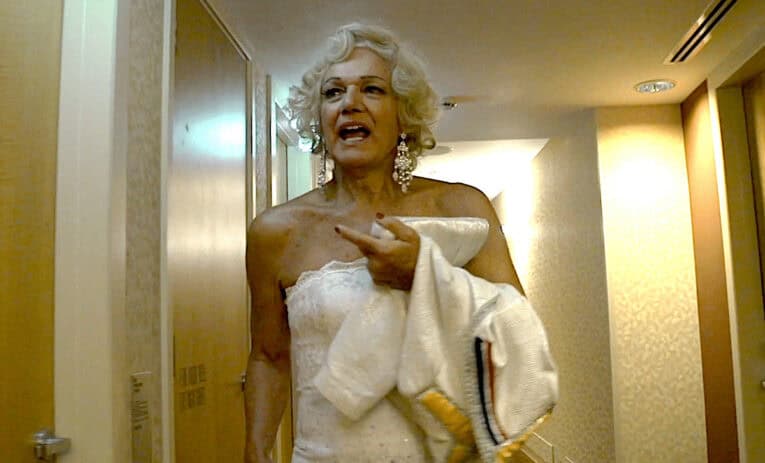
There is a glittery sequence here, filmed at the 2013 Surfing Australia’s Hall of Fame Awards, with cameras and crowds and red carpet, and Westerly cosplaying as Marylin Monroe. This is supposed to come off as a rebirth for Peter-Westerly—but in unguarded moments her smile cuts out, she looks like a sad, scared, caged animal, and to me this bit it is just as grim and downbeat as all that preceded it.
After the banquet, Westerly stops at her hotel room door, turns, bats her eyes at the camera and vampishly whispers goodnight in her best Some Like it Hot voice before disappearing inside. The screen finally, mercifully, goes black for a few moments.

Jump forward three years. Westerly Windina has detransitioned back to Peter Drouyn. This closing section of Life and Death, a brief epilogue, with Drouyn paunchy and slowed down, walking down the block to a streetfront patch of grass where he feeds cheese to the local birds, is almost woozy in its strangeness—but calming, too.
It is also radically out of synch with the rest of the film.
We learn almost nothing about what took place in the years following the awards banquet. My guess is we’re meant to feel relief that Drouyn is alive and more or less at peace. And we do. Because there is hardly a moment in the film, or at least the back two-thirds, where you can’t imagine Drouyn-Westerly going home and dropping the curtain once and for all.
So what happened?
How did Drouyn, after decades of riding out a convoy of likely-never-diagnosed mental issues—line ’em up; mania, depression, anxiety, grandiose narcissism, two or three dissociative disorders—finally level out?
Drouyn tells us, near the end of the film, that “Westerly saved my life,” but leaves it at that. There’s an interview online with one of the Life and Death directors who says something like the “audience will come to their own conclusion” about what they’ve just seen, and about the meaning of Drouyn’s journey.
My conclusion, and I’ll bet a year’s salary on it, is Peter Drouyn is alive today because he finally steered himself, or was steered, to the right doctors, who prescribed the right meds.
I would further bet that this outcome, as miraculous in its own way as it is common, is so unspectacular, so lacking in flair, so totally the opposite of Drouyn’s operatic purple-on-purple life to this point, that he or the filmmakers (or both) cannot bring themselves to tell us.
But come on. Dare to be boring. More therapy and Zoloft. Less Marylin and Brando.
There are many ways to transition.
Commented on Disqus? Log out, tap the Disqus button, and your old name and comments come back. The box is ours.
Your comments are still here. Every one of them.
Twelve years of BeachGrit comments came across from Disqus. Connect and we will show you how many are yours. We get your username, nothing else.
Connect Disqus to reveal.
Peoples willingness to consider challenging behavior, compassion and love are affirming
Sorry, Matt, I don’t think your analysis, while thoughtful and as always well-written, does this powerful and insightful documentary — which by nature of the form is uneven — full justice for how powerful, insightful and honest it is. It’s masterful work.
Truck loads of honesty in in the film, yes its confronting, yes its a cry from the heart of darkness and self obsession and how can life story not be voyeuristic. I never felt I was gawking, i was not there for the eye candy or freak show. I was not there for the laughs, which were plenty – go on have a laugh – what are you worried about? Life and Death is a truly a significant and unique story of the human condition and the relationships portrayed in the sport and and industry surrounding are finally affirming.
Is it better
To have balls
And lost
Or to never
Have had balls
At all
nice read , but , there are couple of things need to be added….I was actually an 18 year old hanging out with Wayne…then Nat…saw all the Bells comps with PD and also Ted spencer…
Peter was better all round surfer than Nat , but not as creative as Wayne in the surf…
Nat was and is a bully ,Peter was eccentric pretty aggro…but so was everyone else from that era…
Peter was an incredible entertainer , he did a a horse race call into a beer jug…..was hilarious….when he went to Hawaii, he was sort of adopted by the Aikau family , he turned up at Lua ….and jumped in with the big Hawaiians and played all those macho men , they loved him then they saw him surf……
Peter’s legacy for us is a great gifted surfer /eccentric but respected/ visionary as he created the man on man competition surfing which we still use today…respect for his journey!
Matt if I ever get USA visa I will come and meet with you as my book is in the making , and will show another much darker side of surfing and some of it’s heros….already had to get legal advice…let there be..truth??
just in time for the holidays…a unisex sweater that we can all agree with comes with a six pack in the front and pj bottoms that are open in the back.
One of Matt Warshaw’s better pieces, I have to say – Peter/Westerly is a complex character.
No points for not understanding him, it is quite likely he doesn’t understand himself but Matt does shine some light into the darkness.
Matt, almost as good as Longtom’s review. That’s a high bar. Best thing I’ve read on here since he left, actually. DR, thanks for finally publishing something worthy of us being surfers with some brain activity.
You could always pay the $5 per month and read all these articles that were not written for BG.
Jeez. This is why we need Matt Warshaw.
Not trying to be a simp, I’m just struck by how rare it is for someone thoughtful and well-informed (Brisick) to tell a weighty story and get a critical and accurate response from someone even more thoughtful and well-informed
The headline needs a tweak though – it’s not the footage of the de-transition that’s voyeuristic and brutal…
Thanks for summary Matt, no interest in watching it.
Peter should have kept the penis and kept focused on the surfing , life would have been much easier imo
Sad but beautiful piece Matt
I think I’ve had my fill of this man and his story no longer really interests me (to each their own), especially as you said he can be an asshole.
But, thank you Matt for the long-read and for continuing to contribute to this website. I really appreciate your writing.
I hope that you’ll continue to highlight some the lesser known core old-timers.
I hope Peter gets some peace in his head. Poor chap.
Is he now a trans man?
eunuch
Neither man nor woman
I remember being fascinated by the ad for Drouyns Island in Tracks. Could there really be 28 waves covering all conditions and directions, found after an in depth oceanographic study of the Phillipines archipeligo? Could these be accessible only to the 50 shareholders who shelled out? Or was it just a fantasy ….
Nearly complete rubbish – a decent reef wave on both the north and the south end of the island, but it’s in the South China Sea, so swell exposure is limited.
Locals go out there and surf it by boat, the land-based surf resort in the area closed years ago –
Have you been back to Cloud 9 much since you named it?
I’d prefer to hear more about and see his photos of Sentinel.
Bad place to break a leash.
I did not go to North Sentinel – but the boat Captain who did told me all about it in a conversation in a bar in Phuket.
You can read about that conversation here –
North Sentinel Island
We have been from the northern tip of North Andaman Island to the southern tip of Great Nicobar Island at Indira Point, but I did not go to North Sentinel – the boat Captain told me the story in a bar in Phuket.
The photographer who was on that trip is still quite an active shooter – but has done nothing to promote his material from North Sentinel, as it is not a good idea to flaunt your illegal images but a magazine did run a feature on that trip back in the day including several images from North Sentinel –
I suppose its not the best idea but sure would love to see how good it really is. Or at least know where to find the article since that can’t be a secret.
Surfers Journal volume 11 #2
Damn, out of stock
The heavy right that’s in the Philippines got some play decade or so back.. What’s the story!
Several times – great to see so many locals gainfully employed with paying jobs on Siargao.
If the Western surfers who whine and complain about crowds at “Crowd 9” want to surf alone, they can do that in The Philippines – just have to take the time, make the effort and spend the money to find unsurfed waves.
If they want to pay me for a consultation, I can tell them exactly where and when to go to do that –
Great read MW 👍