
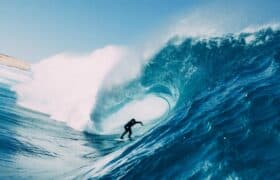



"For those absolute bores who call the ocean their church, prayers to Poseidon are worth a try."
While Surfer magazine whores out a front-page story shilling for the new Chevy Trail Boss, BeachGrit delivers stories that matter, that matter to you, to me, even that chunky kid covered in sand rolling in the whitewash. (You know the one.)
No, I’m not talking about the real estate section, but something almost of equal value: the end of civilization.
Climate change (have you heard?) is apparently set to play spoiler for breaks worldwide as ocean levels rise. According to the National Oceanic and Atmospheric Administration, the sea is creeping up the beach at a rate of approximately 2.5mm per year and that rate is increasing. It is estimated that by 2050, the California coast could see an increase of 24cm. I don’t know metric, but that seems like a lot.
The upswing? We’ll be that much closer to the water from the parking lot.
The downside? You can do the long-range geometry and write the end of the story, but practically speaking, sea-level rise alters the tides and the waves along with them. Imagine your break without a low tide to steepen things up.
But what’s to be done? (Vote NO! on climate change!) After all, we can’t see the creeping ocean so it’s a drag to give effort to something way, way down the line. Just think of your retirement plan. It waits dry as we spring for our third helping of Cordell Millers, and the future just a fuzzy wondering far off in another world.
For those absolute bores who call the ocean their church, prayers to Poseidon are worth a try.
Fortunately, a few vanguards are putting their heads on it in a clever effort to pressure government administrations into action.
The Save the Waves Coalition released a monumental two-year study this week detailing the economic impact of surfing in the Santa Cruz, California area. According to the findings, completed in partnership with the science-minded Black Surf Santa Cruz and funded by the California state agency Ocean Protection Council for 200 grand, surfing around Santa Cruz’s 31 breaks rakes in 194 million bucks annually. “Surfonomics,” as it’s been coined by former Surfrider prez Chad Nelson in his dissertation at UCLA, is nothing new.
Coalition coordinator Shaun Burns describes it simply. “People come here, they spend their money at restaurants, coffee shops. There’s the boardwalk, there’s many places that utilize the ocean and how beautiful the coastline is here. And one of the biggest draws to people visiting here and staying here, even though with sales and rent going up a lot, is surfing in the ocean.”
The Save the Waves research takes Surfonomics a step further by showing a direct relationship between a rising ocean and diminishing economic prosperity for Santa Cruz and elsewhere.
According to the report, “The data and analysis revealed that all 31 surf breaks evaluated will see a decrease in surfable conditions at 1 foot of sea level rise. Even more alarming, at 3 feet of sea level rise more than half of all the surf breaks will be significantly diminished or lost completely, assuming no adaptation measures are taken. It is estimated that up to 40% of revenue generated annually could disappear.
Burns, a former WSL journeyman, stated that the report hopes to push California officials into action. They want to increase the number of surf reserves statewide, “prioritizing surf breaks through climate adaptation, water quality, and equitable access.”
Burns hopes to add to last year’s AB 452, the bill that would allow local governments to identify and conserve surf break ecosystems for recreation and economic value as part of the state’s conservation goals.
“Coastal policy should aim to support decisions and infrastructure that encourages more Californians to visit surf breaks as there is significant economic value that is generated.”
Down the coast, some are taking tangible steps to mitigate the effects of the changing tides and waves. A serious effort is in play to drop an artificial reef in Pacifica, where the break wall is failing as a result of sand loss.
Activists and engineers Rob Caughlan and Bob Battalio are actively petitioning town officials for a rock, steel, and sandbag structure in hopes of both saving the buildings perched above the break wall and increase the flow of dough through added surf dollars. Currently, a similar mound sits in Palm Beach off the Gold Coast and is doing just fine with some right-handers breaking over happy sea life.
For the short-sighted, the artificial reef angle is a win-win. Forget about sea-level rise; we can surf forever, and our town can rake in the bucks. Surfin’s a binez, and binez is good, forever.
But that uppity ocean is still coming, whether we study it, build a $45 million surfing lump in Pacifica, or scrunch our noses as we shake our protest signs at the clouds.
UC Santa Cruz professor Gary Griggs plays spoiler. “We have to acknowledge that the climate is changing,” Griggs said. Sea levels are rising, erosion is increasing, and storms, and the strong waves and flooding they create, are worsening each year. “We’re holding on to an edge that’s moving,” he said, and it’s time to admit defeat.
“One way—really the only way, is managed retreat,” he explains.
De-pres-sive, Gary!
However you slice it, the Save the Waves study provides elected shot-callers with some hard data to chew on. Burns believes it’s a start.
“I kept thinking of the analogy, only a surfer knows the feeling, while working on this project. Now, with this study, the economic value of a wave, and all 31 surf breaks in Santa Cruz, can be communicated to non-surfers, especially policymakers who make decisions based on numbers. Hopefully, this helps show the importance of protecting waves, managing them properly, and including them in future planning and policy.”
Either way, I’m sure everything will work out fine for everyone.
Commented on Disqus? Log out, tap the Disqus button, and your old name and comments come back. The box is ours.
Your comments are still here. Every one of them.
Twelve years of BeachGrit comments came across from Disqus. Connect and we will show you how many are yours. We get your username, nothing else.
Connect Disqus to reveal.
Few things are more substantiated, homie
This is gonna blow your mind but some people own multiple computers
Is this a recycled headline from 1993?
Barry doesn’t seem concerned:
10 facts about Obama’s $18M Hawaiʻi beachfront mansion
Inside Barack and Michelle Obama’s Martha’s Vineyard home – an ocean-front retreat on the iconic Massachusetts island
I do love a reductive question about place I don’t live. So, yes. There will be some effect because of change, I can assure you this of this.
God, it sounds like paradise.
Have you been to Oklahoma?
Can we please just fucking stop with the Rockefeller-created and funded climate change op already? Does anybody here actually read or research outside of state-sanctioned media faucets? Is anybody else ready to forego this juvenile left/right horizontal squabbling for apprehending the vertical nature of our predicament? God, I hope so.
High tide will be the new low tide.
But with many rich whites buying up the coast this could seriously affect the Coastal Western Anglosphere?
For the american readers 24 cm is a 9.5 inches (or one German forearm)
This just further backs my desalination stance….we need to start drinking the ocean.
Okay, next problem?
Equitable access?
Lol you can barely see the articles on this site because of all the fucking ad clutter, but sure, it’s the other sites that whore out their space
Duck duck go
We are so pot calling kettles black etc.
a tax on peeps will fix it for the doomed narcissists.
Just wear thinner tshirts
Already do!
Ahead of your time
The UN predicted in 1989 that by the year 2000 there would be a global disaster due to global warming and oceans rising by 3 feet. A senior U.N. environmental official says “entire nations could be wiped off the face of the Earth by rising sea levels if the global warming trend is not reversed by the year 2000.”
well that says it all…..we’ve been fucked for the past 25 years, so may as well grab the mask and snorkels and enjoy aqua world.
BTW: “Global mean sea level has risen about 8–9 inches (21–24 centimeters) since 1880”.~NOAA August 2023
no wonder their funding was slashed. Can’t even do basic math. 3ft. = 36 inches.
You could see it as being an incorrect prediction, or as a limited success. By calling climate change earlier the limited efforts that are permitted by the heel draggers have slightly slowed the oceans’ rise.
The same question always remains: what do we have to lose by acting on climate change? Less pollution? Sounds horrible.
Less money to the 0.001% if we stop burning carbon. That’s all that counts to them.
Conservatives are misanthropic, hate humans, see us as a dirty/non-heavenly beast and want the least amount of us next to them as possible. They don’t mind people being out in the fields, as long as they don’t have to talk to them or hear/smell them. Strangely, they don’t mind seeing them in the fields.
Conservatives are happy to live 99% of their lives in an indoor, climate-controlled environment. Outdoors is generally to scary for them, as they live their lives in fear. Fear of judgement and fear of everything else.
based on your assertive tone, it sounds like you have 100% empirical evidence to support all the accusations in your screed.
that’s one way to look at it.
the other way would be to say: these UN goons are propagating one. of the biggest lies ever perpetuated on mankind in an effort to establish a “one world” government and bank shitloads of money for them and their corporate overlords. It’s all about the money.
don’t believe me? read for yourself:
Rich nations pledged to contribute at least $300 billion annually to the global fight against climate change as UN climate talks came to a contentious end early Sunday morning in Baku. Developing nations who had sought over $1 trillion in assistance called the agreement “insulting” and argued it did not give them the vital resources they required to truly address the complexities of the climate crisis.
https://news.un.org/en/story/2024/11/1157416
The “green-friendly” investment firm co-founded and run by former Vice President Al Gore, 74, owns a portfolio of more than $26 billion worth of shares in nearly two dozen companies that were found to have increased greenhouse gas emissions in recent years, according to a report.
Bloomberg ranked Generation, which has $40.4 billion worth of assets under its management, as among the companies that owned the greatest share of greenhouse gas-emitting firms when compared to other funds that placed a priority on so-called ESG — environmental, social and governance — investing. https://nypost.com/2023/02/20/al-gores-eco-friendly-investment-firm-owns-shares-in-polluting-companies-report/
Warning the world that it is on the brink of disaster has been lucrative for Al Gore.
His wild prediction at Davos that Earth faces ‘rain bombs’ and ‘boiling oceans’ is just his latest in decades of climate alarmism.
At the same time, the former VP has been at the forefront of green technology investment that has seen his wealth balloon to an estimated $330 million. https://www.dailymail.co.uk/news/article-11653723/How-Al-Gore-300m-climate-alarmism-Former-VP-fortune-losing-George-W.html
in fact of you type in how much money did AlGore, The UN and any other climate bullshit artist make off climate change, you’d be shocked….actaully no you wouldn’t.
you sound like true believer (useful idiot), so would find a way to rationalize the hoax.
nothing wrong with decreasing pollution but “acting on climate change” does not necessarily decrease pollution. Check out the damage that “green energy” rare earth elements does to the environment.
acting is one thing, acting intelligently is another.
https://hir.harvard.edu/not-so-green-technology-the-complicated-legacy-of-rare-earth-mining/
https://ips-dc.org/mapping-the-impact-and-conflicts-of-rare-earth-elements/
https://www.tandfonline.com/doi/full/10.1080/10643389.2024.2406992#abstract
https://www.bbc.com/future/article/20150402-the-worst-place-on-earth
https://www.youtube.com/watch?v=bLFYChw5c0Y
inshallah haha
I like it warm, that last ice age sucked and so will the next one.
Do you like eating food?
A warmer climate and higher CO2 levels will result in a LUSH environment. Look at the 250 million year party the dinosaurs enjoyed.
The Medieval warm period (global temp higher than today) caused agricultural expansion that included flourishing vineyards in Scandinavia. It caused increased trade, economic stability and high culture with prosperity influenced art and architectural advance. A warmer planet is a more prosperous, healthier planet.
Hey real quick, what do you think a Scandinavia warm enough to grow grapes means for places like Australia or most of the USA and Southern Europe and So America and Africa? Anyhoo, I think I’ll go ahead and put my trust in the climate and ag scientists who use the very same scientific method as the scientists who are able to discover things like the Medieval warm period and what it meant for agriculture at the time.
The sky is falling!
But it’s such a beautiful blue
I mean, yeah, it actually is though