


No single person left a blast-zone on surfing as big as the one Larry did in the 1970s.
The Rubberman has bounced, from post-heart-attack complications, age 71. That seems on the young side—although Larry Bertlemann ran full-throttle in all things, his entire life, so maybe not.
Fair to say the Bertlemann legacy is complicated, but I think the top line could not be simpler. If the measuring stick is pure wave-riding talent, plus influence, plus overwhelming flair and charisma—the whole package, in other words—no single person left a blast-zone on surfing as big as the one Larry did in the 1970s.
Yes, my thumb is on the scale.
I was 13 and as impressionable as a half-melted bar of Waxmate when Bertlemann went center stage.
But still.
Fifty years later we are still mostly just doing improved versions of things that Bertlemann (and Wayne Lynch) invented. We are meanwhile still trying, and always falling short, to match the radiant hot-cool star power Bertlemann brought to the game as a teenager.
Bertlemann was just 15 in 1971 when he got his first cover shot, crouched inside a small tube at Kaisers. The following year he made the finals of the World Surfing Championships in San Diego, was very much on radar, but not quite front and center, and still looking every bit the delinquent Honolulu street urchin, missing teeth and all. Hawaiian teammate Michael Ho, in fact, at that moment, was both younger and more eye-catching.
It was 1973 when Bertlemann went from young dynamo to headliner, and he did it mostly on the back of a six-minute feature segment in Going Surfin’, Bud Browne’s last and best surf film. Halfway into the movie we see a trashcan lid laying upside down in the grass. Larry, shot from the waist down, walks onscreen, grabs up the lid with the toes of his right foot, lifts it, flips it over, gently places it on top of the trashcan, and strolls off stage left. He hasn’t even ridden a wave yet, but we’re already prepped for him to be freakishly talented.
The shots that follow (filmed at Off the Wall, Honolua Bay, Velzyland, and Ventura’s California Street of all places) do not disappoint. Watch the entire segment here, trashcan trick included.
But now I have to pause and go History Professor, because what Larry Bertlemann was doing at this point in his career does not really hit unless you have an idea about what the high-performance standard was for those surfers not named Bertlemann.
The famous Rubberman cutback, for example.
Years ago I took a run at explaining in some detail the body mechanics at play, but it’s easier to just look at the photos. These are all from 1973. Jeff Hakman on top, Pipe Master Mike Armstrong, middle, and Bertlemann. No disrespect to Armstrong or Hakman, but that is the performance gap right there, one glance says it all, and until the Free Ride crew came along three years later and turned our heads, an entire generation of young American surfers saw Going Surfin’ and went into full Bertlemann swoon. In the water and on the concrete.
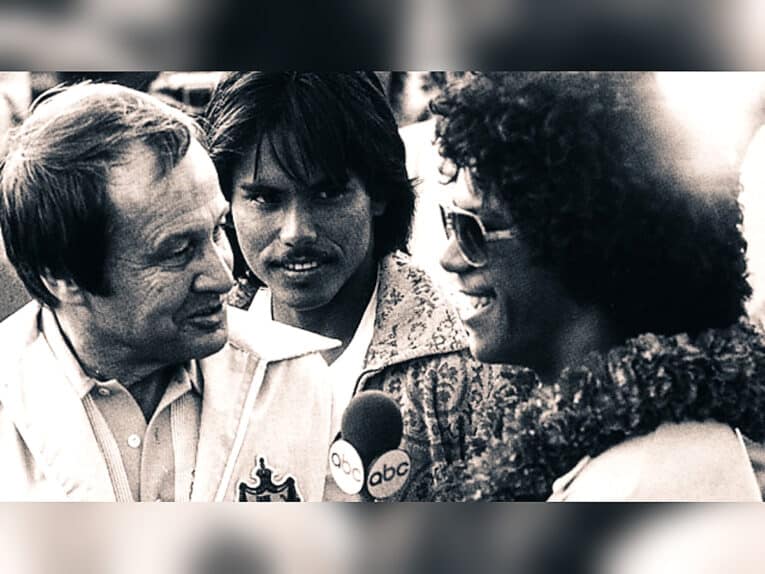
On top of the surfing was the newly and radically overhauled Bertlemann look and style. From top to bottom: huge full-moon afro, Jean-Claude Killy aviator shades, some first-rate dental work, zip-up Adidas track top, and a full collection of candy-colored Ben Aipa surfboards. Everything selected by Larry himself (still a teenager, by the way) who famously at this point told us “Anything is possible,” including this glow-up for the ages. God knows where or how Bertlemann came this level of fashion sense—actually no, I think we can take a guess, and I’ll crib off a story from last year.
Sly and the Family Stone’s “I Want to Take You Higher” was on the radio everywhere 1970, just as I was going full immersion into surfing, and the song continues to fission in my head still, there when needed, a command not only to turn the knobs up but to try and do it all—surfing, skating, dancing, walking from one end of the room to another—with flair and style and joy. It must have been the same for Larry Bertlemann, multiplied by 100. Bertlemann was always going to find a place at the top of our sport. But there is no doubt in my mind that he became the exalted and electrified Pope of high-performance surfing in 1972 only because we’d been prepared for such a figure by Sly Stone.
It took a collective effort—the Free Ride trio of Richards, Tomson, and Bartholomew, and a half-dozen fellow travelers—to displace Bertlemann as the sport’s most progressive and modern figure. Although Larry himself I think would argue that he was not displaced at all because he was no longer playing the same game as the other pros. The just-founded IPS world championship tour was everybody else’s new top priority.
For Bertlemann, however, the contests and the tour were a distant second to sponsorship deals. No fault there. Bertlemann seems to have made a career choice (it wasn’t called “photo pro” at the time, but that’s what it was, and Larry invented it), and while my guess is he didn’t earn anywhere near as much as he claimed, he signed contracts with companies both inside and outside the sport, almost certainly brought home more than the top IPS pros, and for sure cut the highest commercial profile. He had a board designed to look like a huge Pepsi logo, which he then decorated with more Pepsi logos. He later claimed that not only was Toyota paying him, but that they gave him cars to race at the Long Beach Grand Prix. Maybe. Who knows. Larry hustled relentlessly, wheeled and dealed, got the shots, and cashed the checks.
Still, like I say, everything shifted midway through the decade, and for us kids on the beach Bertlemann was no longer the “It” surfer, he was now just a star in a constellation of stars. I wonder how much this bothered him. To take one example—the stiff new Ocean Pacific gear he had to wear in ad campaigns looked like it came straight off a JCPenny back-to-school sale rack. Sly Stone had dropped out of Larry’s head as a style muse just as surely as Stone himself had dropped off the charts. My guess is Larry did not care. Money beats fashion.
Bertlemann had one final cutting-edge moment, in 1984, age 29, when he made the cover of SURFER doing a big spray-making all-fins-out aerial at Velzyland. Cover of the year, easy. On the flip side, Bertlemann jokingly-but-not-really said that these were called “Larrials,” forgetting that unless you’re Muhammad Ali you don’t get to name the stuff that you do. If you’re interested in what happened to Bertlemann over the next few down-spiraling decades—or rather, Larry’s own long-winded and vaguely Colonel Kurtz take on what happened—read Drew Kampion’s 2001 “Rubberman” profile.
Or don’t.
It’s a mostly sad read that dumps you off at a short, devastating, totally predictable epilogue.
Better, I think, to compartmentalize.
For me, Larry Bertlemann exists on a soaring five-year timeline beginning in 1971; the miscreant high-school dropout who outsurfed the world’s best, then dressed up like a surfing rock star in order to become one, then convinced us, for a while at least, that “anything is possible” didn’t mean “anything” it just meant good things.
No wonder we could not take our eyes off him.
Commented on Disqus? Log out, tap the Disqus button, and your old name and comments come back. The box is ours.
Your comments are still here. Every one of them.
Twelve years of BeachGrit comments came across from Disqus. Connect and we will show you how many are yours. We get your username, nothing else.
Connect Disqus to reveal.
Enjoyed!
Thank you, Matt. That was entertaining.
Fantastic surfer who re-defined how waves could be ridden but in reading Drew’s profile, his problems were obvious: alcohol and drugs
Great read and great to see w.lynch mentioned.
Hey Barny do you have the photo of lynch dropping in late on a marengo beast from years ago ?
I do not, mate. Sorry.
Maybe Brutus has one. Or Dez can dip into the dusty archives to dig it out.
No worries..thought I’d ask. He’s on a yellow board. Late drop into a right. Arms back like He’s flying. It’s a ripper.