


Want a joint near one of the best point waves in the world for less than a newish Toyota?
In a nation shrinking by 500,000 souls every year, it ain’t no surprise you can buy a beach shack, right near one of the best waves in the country, the Japanese Pipeline they call it, for less than fifty gees.
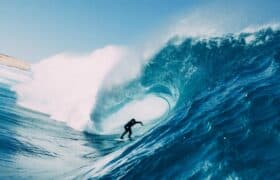
And it’s here on the island of Shikoku, real famous ‘cause its south-east facing Pacific coastline snatches all them powerful typhoon swells, and near a pretty rivermouth wave called Kaifu Point, where you can buy a turnkey beach shack, built in 1992, all trad Japanese tatami mats etc, for forty-five gees.
Kai Neville knows how good the joint gets.


The fifty-gees for a beach shack is the sort of deal that has gone viral on social media. It fuels those long-forgotten dreams of westerners who will never, and not in a thousand years of scraping together a little something every week, get close to buying a joint somewhere they want to live.
Why so cheap? A little history lesson.
There’s a reason that beach shack is so damn cheap

Credit flowed like gravy. Banks lent freely against ever-rising collateral, companies speculated in real estate instead of their core businesses, and ordinary households took out 100-year mortgages.
By 1991, urban land was priced at levels implying Japan would generate the entire world’s GDP growth forever.
The Bank of Japan pricked the bubble in 1990 with sharp rate hikes and lending caps. By 1992 the Nikkei had lost half its value. By 2003 it had taked eighty percent.
Like, brother.
The fallout hit everything.
Banks drowned in non-performing loans, construction firms went bust, and millions of homeowners fell into negative equity.
Rather than foreclose en masse, which was gonna be culturally and legally difficult, banks and owners simply let properties sit. New construction slowed dramatically, and the cultural preference for “new builds” hardened into dogma: why buy a used house when land itself is no longer seen as a sure store of wealth?
Three decades of deflation, stagnant wages, and population decline later, that 1990s price anchor still holds. Rural land, never as inflated, fell even harder in relative terms.
And here we are: a 1992-built beach shack on Shikoku coast that might have cost $500,000 equivalent at the bubble peak now trades for one-tenth that. And it ain’t because it’s worse, but because the greatest real-estate mania in history ended exactly there.
Japan’s real estate is a paradox, of course.
In Kochi Prefecture, home to Kaifu Point, the median detached house price hovers around $140,000 to $180,000, per 2025 data from real estate aggregator AkiyaMart.
That’s a fraction of the U.S. average, and even less than the mania that is the Australian housing market, but the $50,000 tag on this property underscores the extremes: It’s an akiya, abandoned by heirs who fled for urban jobs, and now peddled through municipal “akiya banks” to stanch rural decline.
Rural areas like Kochi, with its misty mountains and typhoon-lashed shores, have been hit hardest: The prefecture’s population has shrunk 10 percent in a decade, leaving schools shuttered and supermarkets sparse.
If you’re young you split to Osaka or Tokyo for work, abandoning those family beach shacks you neither need nor want.
“These properties become burdens,” says Shu Matsuo Post, founder of the financial blog Post FI, who bought and renovated an akiya in rural Chiba for $30,000. “Heirs pay taxes on land they can’t sell, so they list them cheap — or abandon them altogether.”
Compounding all that is a cultural aversion to the old.
Unlike in Europe, where centuries-old farmhouses fetch premiums, Japanese homes depreciate rapidly, often designed for a 30-year lifespan.
Postwar building codes prioritised affordability over longevity, using lightweight timber vulnerable to earthquakes, humidity and typhoons — Kochi averages five major storms annually.
Renovations on a beach shack to meet modern seismic standards can cost $100,000 or more, per estimates from Cheap Houses Japan, a site cataloging sub-$100,000 listings.
Buyers want new builds with warranties,” explains Michael of the blog, who notes that 80 percent of Japanese households opt for fresh construction, viewing older homes as liabilities.
Superstitions linger too: Some akiya are shunned as haunted by the spirits of solitary elders who died alone, a nod to the nation’s 30 percent rate of “kodokushi,” or lonely deaths.
Still, forty-five gees for a beach shack, near a rivermouth goldmine that turns its lights on mid-to-late year and bragging rights when you’re telling some gal at the bar about your Japanese retreat.
Are you a little tempted?
Commented on Disqus? Log out, tap the Disqus button, and your old name and comments come back. The box is ours.
Your comments are still here. Every one of them.
Twelve years of BeachGrit comments came across from Disqus. Connect and we will show you how many are yours. We get your username, nothing else.
Connect Disqus to reveal.
Ha! This is exactly what’s happening at my local spots. All the Covid blowins who moved down together from Kansai (mostly) have tried to band together and take over. Half of ’em still have Kyoto/Osaka/Kobe number plates but ride down the beach with their bikes and surf racks and trundle up and down the street with their new dogs and think they’re locals. Give you stink eye when you paddle out or dare to paddle for a set they might be eyeing off. Told a bunch of ’em to fuck off back to Kansai with all their other blowins.
One might say it’s ironic, considering I’m a foreigner, but I’ve been here nearly 20 years and I know every person who’s surfed these spots for years before the Covid blowins arrived. They’re such blowins they don’t even know who’s local or not. Think that coz they’re from the big smoke they can act the tough guy. Most of ’em are kooks wearing fedoras who care more about their Insta Reels than how they surf. Love hearing ’em grumble when they work out that I’ve been there 10x longer than half of ’em.
Brutal
https://uploads.disquscdn.c…
Japan as we know it and hope it will always be is disappearing in real time right before our eyes. It’s honestly shocking. My wife is from a very small island south of Kyushu and every time we go back there all I hear about from my in-laws and other family members is how so and so passed away, or how so and so is now in hospital and has no-one to care for them because all the family members have skedaddled to the cities.
My wife and her siblings are a good example. Her family runs 6 generations deep on that island but my wife and her brother and sister have all moved away. Who’s gonna take care of her parents, their land, the machinery, the farms, the house? That’s happening right across Japan.
The irony is that these foreign vultures are trying to make a buck off these abandoned places like they’re a lifetime golden egg. Why the fuck you think they’re all empty? Coz there ain’t no jobs, industry, or fuck all else to sustain the areas.
Absolutely true – Japanese are downright paranoid about foreigners who want to live in Japan (always have been) and unless you are the right sort of foreigner, meaning white, educated and rich, the jichikai meeting will block you.
Thanks.
been through a few of those Q&A for business.
I lived in Japan for 8 years (88-96). Only went to Shikoku twice.
Thought it was beautiful. most of the surfers (when I lived there) were pretty cool, but few even paddled out when it was over 4ft HI.
there were a couple of hardline “locals” who acted a bit tough, but my sponsor and Hawaii connection made life pretty easy.
BTW- when i lived there, there was this ozzie pro, who would wipe the floor with all the japan pros. you know the guy?
If it was Kaifu, probably Adam Faunce.
I thought Piperine was a reft?
You have only been on that island for 237 years and stole it from those who had been there for 65,000. What cultural heritage are we talking about? Drinking piss, bbq’s, bar fights, RSL’s, meat platter raffles, bowlos, Akubras, Steve Irwin?
Best real estate story you’ve written DR, fascinating
Yamato Japanese, unlike Australians, are not descended from convicts, deported from their own country for “the term of their natural life” – just saying
Haha Dez did you just copy that entire article? There’s some big mistakes in there, but whatevs. Shikoku is fucken rural. Kaifu? Bumfuckingfuck nowhere. But you left the best bit out for people overlooking the remoteness and fuck-all-to-do cautions.
It’s perhaps the most localised wave in Japan. So remote that old school rules rule and no-one does fuck all to stop the localism that still rules there.
Adam Faunce lived there for a long while but exited on not such wonderful terms.
Telling people to spend money on a dilapidated shack and go surf dream waves there is kinda like those fucking parasitic surf guides who take total beginners out to good spots on good swells and push ’em in on soft tops without even looking sideways and hoot when they stand up. Then disappear when they crash and burn and get tangled up in reef and leash.
PSA: Don’t surf Kaifu unless you’re with people who surf Kaifu. Sure as fuck don’t buy a shack out there.
what vid was this from again?
absolutely mental waves.
https://uploads.disquscdn.c…
Lost Atlas I think…
queer suburbia.
Jesus, I mean Buddha fucking Christ, I love Japan. Last major country on the planet where people have respect for themselves and others around them. Calm quiet house somewhere you can get okay surf, dirt goddamn cheap, and neighbors who are going to befriend you and leave you alone at precisely the right levels? And depth of the long winter powder in the trees 3 days after the storm no problem. Yeah sign me up for that
Mono culture!!
So funny to see kelly commenting….and just because you buy something near a surf spot in Japan, especially a rivermouth……does not guarantee access, Kell got banned for not showing respect and asking for an invitation off the bossman……
It’s all about respect in Japan, but once you’ve shown respect….they are some of the kindest and gracious people ever.
Shikoku is awesome and most of the surfers are super cool.
Actually learned something on this one, DR. Thanks.
What are the employment opportunities?😀
Zero!
great base for BG
Byo laptop
For gaijin in rural Japan, who can’t speak Nihongo and have no formal permission to work?
None.
How do you look in a maid costume? Don’t worry, there’s no actual cleaning involved ….
Buy the property, toss in a couple hundred to build a nice B&B, and you’re gold.
awesome place to live. Osaka is pretty close by train. plenty of employment opportunities in Osaka.
how often does it look like that?
September only?
A few times in typhoon season.
Lovely prefecture,but this is rare, crowded and hassly.
I don’t know Shikoku that well.
Honshu (east side) gets waves year round as its exposed to all Pacific swells, and sometimes gets fun surf in the Sea Of Japan (west side).
Fukuoka also has some good surf.
Japan can get good – very good https://uploads.disquscdn.c…
Just asking –
“It is not possible to provide an average or typical income for a “gimp for bored housewives in rural Japan” as this is not a formally recognized or regulated profession, and the adult entertainment industry in Japan is complex and largely informal outside of major urban areas and established film production”
Already trying to convince my wife
Dump her, brother, find a pretty lil thing, busty ideally, Tokyo based. Divide time.
Hahahahaha
A flash in Japan.
Stick man there are times during my day of sweating and hammering nails when I will take a little break and have a squizz on here and your word plays always bring a much appreciated smile to my dial. Thanks heaps cunt, good onyas and keep up the good work
☺️