


"If I had to, I would go out another thousand times to fight for the country without thinking twice."
It ain’t easy defending y’turf from homicidal religious zealots, all of ’em armed to the teeth, and none of ’em noted for giving mercy to their enemy.
The surfer Tamir Dudi knows.
He’s already survived the worst day of his life twice: once in a Gaza tunnel-fight where three grenades landed near him and a bullet banged into his leg, and then on an operating table in Austria, where he asked a surgeon to take the arm the war had already destroyed.
Dudi is twenty-six now and the former IDF lieutenant is training toward making the podium at the world adaptive surfing championship in California this November.
Dudi grew up surfing the pretty little beaches around Tel Aviv, then mostly stopped once life intervened, a pre-military prep program at 18, then the army, then a slot in Nahal Brigade’s reconnaissance unit. He was waiting to start a company commanders’ course when October 7 hit. His unit was rushed to the communities ringing Gaza, into fighting around Sha’ar HaNegev and Mefalsim, and into the bloody work of pulling wounded survivors out of the Nova festival grounds, the same massacre celebrated by prominent surfers and celebs in the West.
Three months later, on January 16, 2024, his unit was fighting in Jabaliya when gunmen did their little Jacks-in-the-box out of a tunnel shaft and tried to ambush them.
“Three fragmentation grenades were thrown at me and I was shot in the leg. I was lying on the ground and saw that my whole body was torn apart, but luckily my team pulled me back and saved my life.”
A helicopter got him to Hadassah Ein Kerem in Jerusalem and from there began a punishing circuit of operating rooms in Israel, the U.S., and Austria, all up seventeen times under the surgeon’s knife.
“I had severe nerve damage in my leg and arm and understood that I would never return to full function,” he said. “I went through an emotional and physical roller coaster knowing that I had lost my independence.”
For eighteen months, doctors kept trying to salvage both the leg and the arm. Dudi , meanwhile, kept looking for a reason to get through it.
“After a year and a half of hospitalisations, releases and attempts to save my left leg and right arm, I looked for something that would comfort me, something that would give me hope again.”
So he called a pal who taught surfing and asked, bluntly, what it would take to get him back in the water.
“The answer I got was: ‘You’re nowhere near it,'” Dudi said.
By that point his right arm was dead weight, paralysed and in constant pain, with doctors telling him there was no real chance it would ever work again.
Dudi figured, screw it, cut it off.
“I flew to Austria for the amputation. The doctor there told me, ‘You need courage.’ It was done on September 30, the eve of Yom Kippur. I woke up from the amputation with my whole family outside and I was smiling. I believed things would be okay and that I would find a way to get somewhere good.”
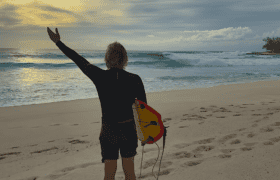
Losing the arm made him more determined to surf, not less. He went straight to a Tel Aviv beach and tried to stand on a board with one arm, which turned out to be about as hard as it sounds. Dudi could barely balance, let alone paddle.
“I tried again and again and saw that it was getting better,” he said. “I managed to do it, barely, far from where I needed to be, but there was a direction… I learned to love my body again.”
“When I arrived for the first time, I decided that I wasn’t surrendering to any limitation and that I was going back to surfing,” he said.
A coach there, Daniel Sigura, saw something in him early. “You have the potential to go very far, you just have to keep at it,” Dudi remembers him saying.
Three or four sessions a week became the spine of his new life, eventually leading him to a training camp in California.
“There are endless falls and the question of whether to get up in the morning and why,” he said. “Surfing is a great reason to start the day. The water is healing for me, and after I nearly lost my life, I’m entering this journey with everything I have and with maximum focus.”
Five months into his training, the coaches around Dudi stopped treating him like a rehab case and started treating him like a contender, this in a sport, adaptive surfing, that hasn’t yet made it into the Paralympics.
Billabong and the equipment company Ultra Wave have since signed on as sponsors.
Going into the world championship, Dudi isn’t pretending the field is easy, but he’s not lowering the bar much either.
“If I had to, I would go out another thousand times to fight for the country without thinking twice,” he said. “I don’t think I’ll be world champion in November, but I want to stand on the podium. To know that I won.”
Commented on Disqus? Log out, tap the Disqus button, and your old name and comments come back. The box is ours.
Your comments are still here. Every one of them.
Twelve years of BeachGrit comments came across from Disqus. Connect and we will show you how many are yours. We get your username, nothing else.
Connect Disqus to reveal.
Good to see Dez is getting no bites on this article.
What a pussy
For a while there I was wondering if he was riding a Coil surfboard. But I think that the two insignias are only similar, but slightly different. Likely an Israeli shape. They’re good with technology, those Israelis. https://uploads.disquscdn.c…
So everyone knows that Tyler is retiring right…otherwise you guys would have had it up by now if it was a scoop.
p. s. Tyler’s retiring
Retylering
Maybe transgressed the Wright family code of you claim anything under an eight and you’re done.
I’m a real instigator, aren’t I.
If you believe houshmin and his ” mates ” then yes ! BUT I DON’T!!
…been drinking. He’s super dehydrated.
Armed and dangerous!
I’d give an arm and a leg to lend him a hand…
Anyone who goes out on a limb to lend a hand is alrigh…errr all left with me.
Whatever happened to helmets period ?
caught inside at heavy Matrix’s!
I dunno what that is so I’ll upvote and downvote on alternate days
One of the heaviest spots here on the internet…💀
Hectic current
Sharks, etc…
Ran out of watermelons
et tu Batman ???
You better come back bruz, you funny as fuck and a great bloke Chunks.
Don’t you dare leave me here with all these fuckwits.
Xox
you want to discuss your views …which are right wing…..as others have also seen here…….that’s mine and others opinion based on what you have written here………
If you are not secular, what spiritual orientation are you…..??
Sorry to be off-topic on poodle avatars and whatnot, just a reminder:
“Palestine” is a fictional entity. It is not a country and has never been a country, not for even five minutes in 3 000 years of recorded history. It will never be a country.
“Free Palestine” is nothing more than a socially acceptable warcry of hatred for the Jewish people and for the eradication of the State of Israel.
As long as people like Tamar Dudi are more than willing to serve in the IDF and give their lives a thousand times over for the State of Israel, the nation will live and prosper.
Just because you’re racist and Islamophobic (but definitely not homophobic) doesn’t make the Nazis the good guys.
Who’s that ? John septic cameraman or jenn see. ? They’re the only 2 to block me atm.
JSC of course!
You should move there.
“While automatic immigration and citizenship in the State of Israel (known as Aliyah) are reserved for individuals with Jewish ancestry under the Law of Return, non-Jews may obtain legal status via alternative routes governed by Israel’s general entry and citizenship laws”
never seen one, but heard of them.
what? a goodbye post, what for?
Knickers in a knot cos he showed a photo of himself, then deleted it
But others on here had saved it and showed it too, but then also deleted it
You and I are probably the only ones who haven’t seen it by the sounds…
and me….a surfing photo of someone, can’t wait!
the Fiji one?
that’s a weird thing to quit over.
Strayan, your joking right?
Yeah apparently at Cloudbreak from what I can read between the lines
Dunno about the Negs one though
He’ll be right
Me neither. Oh well. More important things in life. I’d rather look a pics of girls than guys anyways. Hahahaaa
Here’s a photo of a girl, for ya. And a duck. https://uploads.disquscdn.c…
Thanks, more interesting than a pic of some bogan who I don’t even know or care what he looks like.
Another watch worthy comment.
I missed it too.
Ditto. Whatever.
It’s a photo of him standing in a sick pit at Cloudbreak but his face is blanked out so not sure why he’s so wadded up.
Negs photo was quite a while ago but likely still up.
he also posted an entire video of himself a while back when he first started posting here
That was a clip of his mate I believe
thought it was that he and his mate did a collab on the video but the surfing was him – don’t care one way or the other , just seems like a bit of an overreaction generally
https://uploads.disquscdn.c…
A hero in so many ways..
Good luck at the comp
The things people go through and keep on surfing..
He should stay at arms length of the Israeli spin doctors if…oh wait
back in 236 BC……..all women and children were massacred…….ah then the was 70Ad……serving up 5 minutes of history from 1947…..LOL……did you know Palestinians were offered a homeland same as Israel in 1947…they refused and attacked Israel the next day….as they did again in 1966, and 1972…the Oct 7……hmmm seems to be working well?
Criiikey, all this avatar stuff is pretty blimmin’ gay
And not honest man on man Derek & Sasha brokeback kinda gay either
Just 12 yr old girl Taylor Swift mega-fan lining up for tickets kinda gay
Am I, Boggy, Barrelled and (obviously) Brutus the only ones here who actually have pictures of ourselves beside our names ?
How do we know that Sofa really is a woman ?
Might be a 16yr old schoolboy for all ya know
What about JJ’s Johnson ?
Could be a 61 yr old woman
Unless youve met them in real life, or spoken on the phone, ya just wouldn’t know
Am I the only one not to have seen the photos of SCunt and/or Negs ?
And why does (almost) everyone get their knickers in a knot over an occasional downvote ?
Sooooo many unanswered questions
Oh yeah, go the one armed Israeli, what a champ
About time he got a watch sponsorship.
P.S.
Though after watching his Instagram video, he’s not exactly armless like Bethany, or even Jimbo, just a hand and wrist missing, and can still paddle and use his arm as a pendulum anyway…
That’s what happens when we don’t get the daily Gritty…
I am running out of paper for the cat litter tray.
Get to work
A great read, and it doubles up for the litter tray. I dunno what I am gonna do without free newspaper anymore.
in real life I’m an Ohio house wife making up shit from looking through old surfer mags on warshaw’s site
https://uploads.disquscdn.c…
I love the arm definition, Rocks. I see that you’re a bit of a clothing designer yourself.
Where was the break?
FL fashion rules 101
this was at cliff overlooking roca loca in CR , a little north of hermosa. Roca L proper is to the right out of frame , this wave breaking out beyond it
btw , von rupp is on a heater of a revenge tour , has become a very entertaining follow the last few weeks
youtube? podcast?
his IG … apparently he broke up w/ his model/actress fiancee a few months ago , which appears to have inspired a nonstop run of posts featuring some pretty good surfing and impressive baddies – much of it in his stories so gone after 24 hrs, but he’s throwing serious heat
My photo is actually me sadly, if you look closely I am wearing a Gene Simmons tee shirt.
Xox
That’s soooo cute
I passed Michael Flatlately’s pee test.
Hhmmmm, I have to admit I’m still a bit suspicious, especially seeing as teenage boys are the main culprits for knowing about changing avatars etc.
Plus I do wonder why an apparently sensible mother would associate with a group of international weirdo’s in the BG comments dept.
You might have to turn up to Tower 9 and Larry’s Beach Club in October for personal verification…
If I were you, I probably wouldn’t believe me either.
I can’t really explain it beyond that I get a lot of laughs here, and I like that it’s a global community.
I’ve said before, if it ever worked out, I’d be happy to meet up in a public place.
for someone who has no spiritual grounding….you resort to being good and me evil…LOL……..OXY/AUSSIE moron?
oh yeah….it’s been a long journey with blowie…and it’s only coming out now how right wing and colonial his vews are….like red rag to a bull……like below he says he is good and I am evil not understanding that’s a spiritual statement , ah ……lucky it’s not the good Ol days…..