
"It was horrifying, but what mattered was the quality of what ended up on the light table."
“We were in a rarified world doing what we loved. We did anything we wanted, went anywhere we wanted, and were paid for it.”
Doors opened wide if you were Jeff Divine, the prolific lensman, former photo editor of Surfer Magazine and The Surfer’s Journal, who spent fifty years capturing images of a world he helped create.
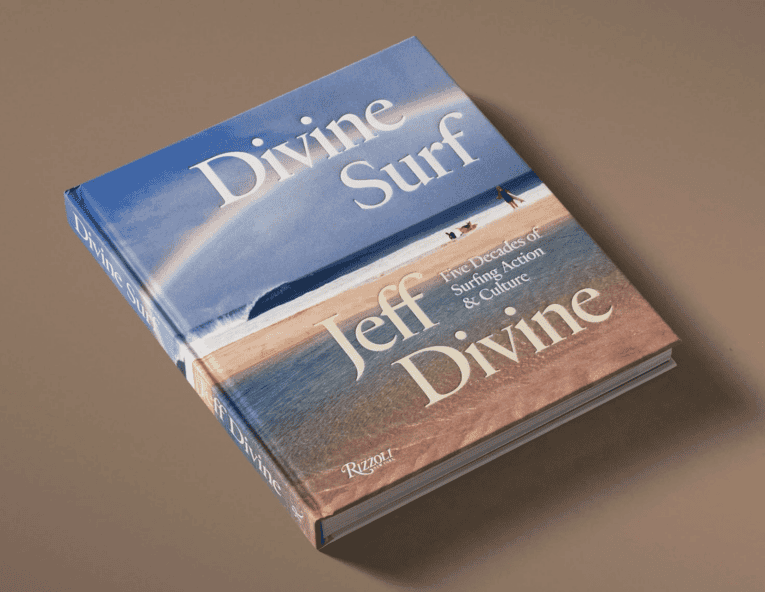
His surf history anthology is now available for close inspection in Divine Surf: Five Decades of Surfing Action and Culture. It’s a brick-high retrospective of the images that helped shape the sport from outsider oddity to quintessential cool. Filled with hundreds of glossy shots and a forward by Matt Warshaw, the book should be read with a bib. The hardbound collection traces a 50-year arc of surfing through his most recognized work dating back from the mid-sixties when Divine popped off his first shots.
Divines’ body of work revels in the spectacular finite moments of surfing; there is no before and is no after, only captured frames of perfection to tell a story, however incomplete; the ugly parts are left to the imagination: travel dust in the teeth and cuts on feet on reef. But it’s exactly what Divine chooses to leave out that makes magic on the page. The viewer puts his jealous little face up to the paper and lusts to be where he’s been: under the lip at Pipeline with Tom Carroll, Avoca with Nat Young, Namotu with Bobby Martinez, and even his hometown of La Lolla Shores where the young Divine introduced himself to photography.
At 14, the young Southern California native grabbed a little Pentax A1A and began clicking anything in view: puddles, trees, sidewalks, the ocean. Classmates paid Jeff a dollar a pop to take a photo of them surfing. At just 18, he snapped a frame that landed on the cover of San Diego Magazine, a sundown shot of La Jolla Cove with tuna boat silhouettes in the background and agave trees in the fore. Dad was an architect, mom a music major, and grandmother an artist, each providing equal parts encouragement and genetic code.
Divine figured out early that his DNA led him to photography. “We are all unique like fingerprints,” he says. “The camera is just a tool, a planer, it’s within the person to make the art with that tool.” His natural ability for composition came through quickly.
His grandmother told the teenager to gather his ten favorite slides. She gave them to a well-known photographer because she wanted to know if he showed promise in a professional’s eyes. It was the first time someone said, “Oh, you’ve got talent.”
“I was just following my instincts. I started surfing in ‘54 at 14 and became enamored with the perfect wave,” Divine says. “Then I started playing around with the camera down at Big Rock and Windansea.” At the time, few photographers planted themselves on the California coastline. It was wide-open, free-range wilderness and rare to see someone else shooting. It was like the kid down the street with an iguana. Unusual.
His first shot in Surfer came in ’68, a graceful Margo Oberg slipping across the water perched on the nose at Hammonds Reef. Divine’s family and friends recognized his early talent, and when praise and passion combine, a career likely follows.
“I was so immersed in surfing that there was never a question and never looked back,” says Divine. “I started getting photos in Surfer magazine and completely immersed in the craft and addicted to surfing.”
Largely self-taught (Divine says neither he nor the prolific elder lensman Ron Stoner possessed the dispositions to exchange ideas. Divine too shy; Stoner too gone.), Divine spent the next few years up shooting what he could to sell to Surfer Magazine for $25 an image. He shot up and down the south California coast: Huntington, Laguna Canyon, Santa Barbara, anywhere and everywhere he could point. He regularly visited the ballroom floor of the very private Hollister Ranch, often motoring in from Gaviota Pier. Ranch manager Dick LaRue brought opened the gates for him hoping the photos divine sold to Surfer would act as marketing promos to sell off parcels of the 136 parcels of Santa Barbara land. Locals there, however, eyed him as custodians do gum in a urinal. Within minutes of setting up his big lens tripod, they’d yell at him to get the hell out.
“Yeah, I got hassled at Hollister. I felt bad about that because I agreed with having it kept private, especially how crowded California was getting,” he says. It didn’t stop him, however, from slinking into the shadows, covertly snapping away at the dancers.
The evolving culture of the late 60’s brought an end to the apparent innocence documented in early surf photos of the era. No more soft black-and-white images of teenage boys goofing in the sand, rolling down the dunes. No more white smiles beaming from the windows of mom’s wagon. The decade traded madras for madness and calls into question even today what the halcyon days really were.
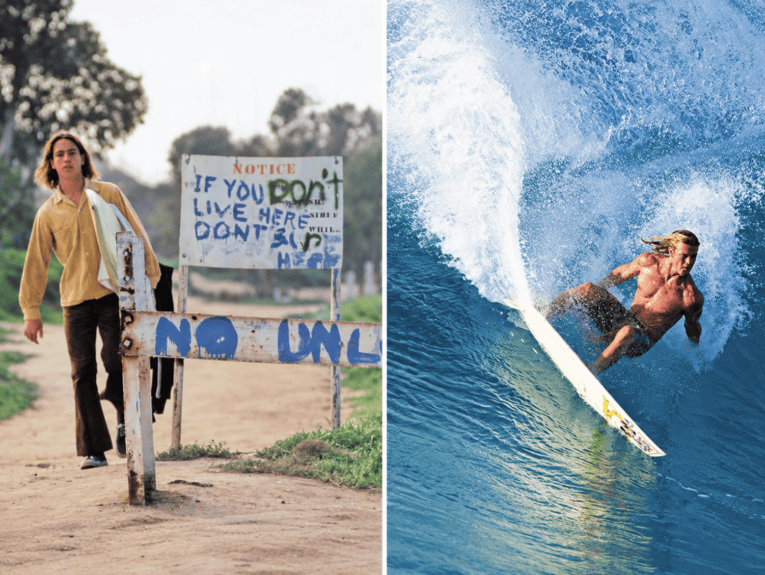
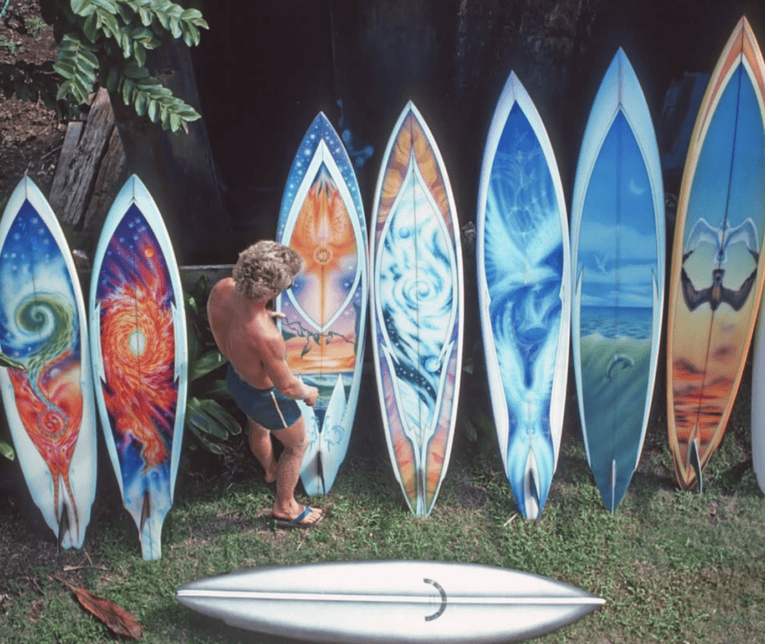
Divine captured bearded flute players, hand-painted milk trucks dripping with starbursts of color, and concerts on the sand filled with stoned and swaying kids. A famous photo shows David Nuuhiwa, considered to be one of best surfers at the time, huddling on the ground next to the infamous John Gale, flanked by a teen bent over staring into the psychedelic airbrush of a Rainbow twinny. Surfer sent Divine to get shots of Nuuhiwa and ended up at Johnny’s, home to the Brotherhood of Eternal Love. Gale would later be arrested on drug trafficking charges. Such was the culture.
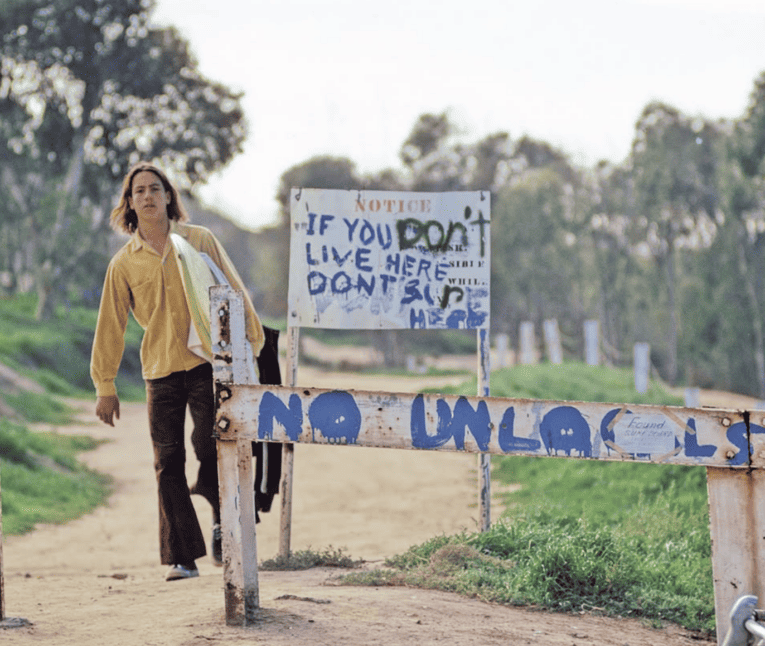
As Californian breaks grew more crowded, surfers of the 70’s searching for bluer, steeper pastures leapt across the Pacific and Divine followed, setting out to shoot the evolving scene of the Hawaiian Islands, Oahu in particular.
He aimed his lens at anyone competent at Pipeline, regardless of status. Even “neighborhood nobodies.” These, according to Divine, fell into two categories: the “sons and daughters of people who had real jobs in Honolulu. Some were derelict, hang-at-the-beach-all-day types. Others were transplants enamored with the North Shore lifestyle that, within months, had them speaking mangled, faux pidgin.” He shot them all, and sometimes exclusively owing to clever Hawaiian tactics, forcing everyone out of the water except themselves. “Everyone’s the same,” Divine laughs. “Everyone wants their picture taken.”
But hunting the big names were the real prize: Terry Fitzgerald, Barry Kanaiaupuni, Jeff Hakman, and the whole gang in and out of the water, including the front porch scene of who’s who at fellow lensman Bernie Baker’s house overlooking Sunset, then the universe of the North Shore and later, the family portrait of the Astrodeck Wave Warriors.
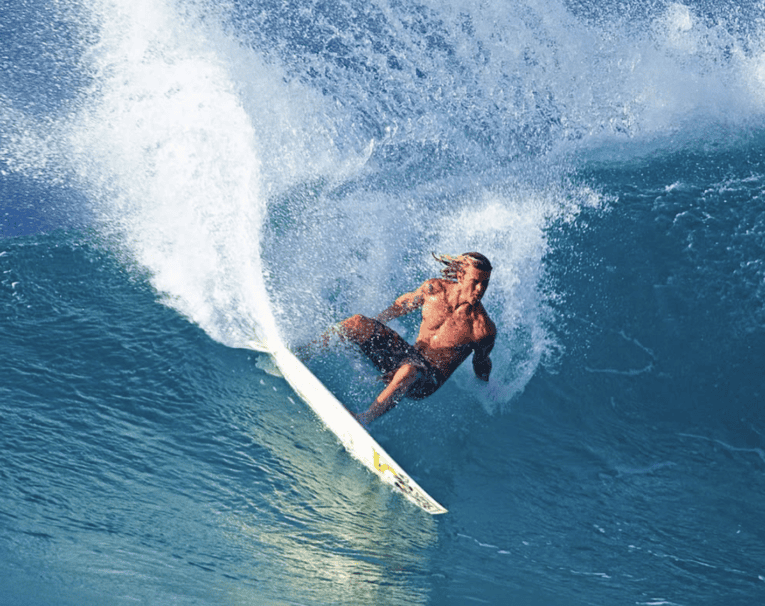
And there was plenty of Gerry, loads of Gerry. During the 70s, Divine snapped the most inarguably famous frames of Lopez ever captured. The rawboned Hawaiian with an unspooled spine redefined tube riding while atop his hand-shaped Lightning Bolts, the proof landing front-and-center in the pages of Surfer. Today, he and Lopez maintain a friendship, but the two never spoke during those seminal years. Divine chalks it up to their equally quiet dispositions but is still curious, as much of their careers were made from one another’s performance. (Similarly, Divine and 11-time world Champion Kelly Slater never spoke when housed together on a Tongan boat trip.)
And there’s the iconic shot of a young Buttons Kaluhiokalani prone, looking back over his shoulder, flashing a peace sign and a million-dollar smile. “It was a right place, right time” moment. A mix of town guys and locals crowding the lineup caused occasional tension. “Buttons burned this local guy with a purple mohawk and ponytail. Scary guy. He freaked out on Buttons, screaming,” Divine recalls. “But he just turned around, stretched out a peace sign and said, ‘Peace, bro.’”
Click!
Divine lives by the rule that a photographer does not put himself between the camera and his subjects.
The late Diane Arbus wrote that “the camera is a kind of passport that annihilates moral boundaries and social inhibitions, freeing the photographer from any responsibility toward the people photographed. The whole point of photographing people is that you are not intervening in their lives, only visiting them. The photographer is super tourist, an extension of the anthropologist, visiting natives and bringing back news of their exotic doings and strange gear.”
The artist doesn’t interpret, it’s said. He visits, walks into someone else’s life for a moment to observe. Takes a snapshot of another’s life. Put enough snapshots together and we get a flip-book history of the times.
Divine’s skill for composition positions us into the scene, perfectly in frame and focus. We look, our eyes bouncing around the corners of the page and leaning into the fine print to fill in the blanks of what happened, creating little stories in our heads, trying to feel what it was like to be shot out of the barrel of a gun.
Yet the impossible neutrality of the photographer is revealed in direction of his lens. After nearly a decade planted on the North Shore, Surfer chief Jim Kempton offered Divine the role of photo editor after Art Brewer’s departure. He flew back to the mainland and suddenly found himself the arbiter of cool, “the guardian of the gates,” as he explains.
“The aim at Surfer was to show the best surfers on the best waves. I was looking at it from the core to show it to the outer world. It was all about our world,” Divine says.
Photos in each edition showcased that world to surfers exactly what was possible and what it should look like: Crouch and tuck knee mid-face like Tom Curren? Got it. Hold front arm down like Peter McCabe? Will do. Square shoulders like Shaun Thomson? I’m on it.
Style bled through the magazine pages into readers’ idea of what a surfer looked like on land, too. When asked about his influence on curating the culture, Divine plays it cool.
“We weren’t interested in the fashion but showed it as it was. In the sixties it was khakis and a white t-shirt maybe with a stripe across it. In the 70’s we were traveling more and bring things back from where we surfed like the Mexican wedding shirt or huaraches, or wrist bands from Bali, or custom-made shirts from hippies or puka shell necklaces. It was the natural look,” Divine says. “We were rebels, outdoorsmen, and all that vibe in the 70’s specially that affected the fashion thing.
“I read an article in the NY Times that it was the cool thing to have a Surfer magazine on the coffee table. But we couldn’t care less.”
However unconscious Divine and the boys at Surfer appeared, their monthly spreads proved too attractive to the under-30 crowd that swung from the coasts.
As Surfing: The Lifestyle! caught America’s collective eye (so shiny smooth and tan), surf companies – like all companies do – smelled cash in the water.
“When the action sports thing came in in the 80’s, it changed everything. Prior, we had no nothing. We’d carry a brown or a Oaxaca bag like you carried groceries in in Mexico. All of a sudden, we had everything. Companies would send us hats, shorts, the whole nine yards.”
While brands pushed and pulled to bend the culture in their favor, Divine managed the sea change with aplomb, ensuring Surfer’s traditional ethos remained while still growing the mag. Companies wanted photos of their guys wearing their trunks, their watches, and their stickers featured. “But criticism didn’t faze us. We had a ton of confidence. Some didn’t understand how we made decisions. They didn’t have a clue what thought went into each issue,” he says.
As photo editor, choices had to be made and the “best surfers on the best waves” guided image selection under Divine’s careful eye.
“We were good at what we did.”
Did it make everyone happy? No.
Aside from the corporate tugging, countless freelance photographers hounded the photo staff. Some were desperate, some money hungry, others drug-crazed and unstable. “It was hard to deal with everybody’s baggage. It was horrifying, but what mattered was the quality of what ended up on the light table. Some of the craziest photogs had the best pictures. We just wanted the best work,” Divine recalls. “I was always nice and charming, but it was tough to deal with people who came in to show me their average pictures, but we treated everyone nicely. But you can’t tell people their babies are ugly, so it was tough.”
After almost twenty years at Surfer followed by a long run at The Surfer’s Journal, Jeff said goodbye to official editorial duties to focus on independent work, recording critical moments in surfing well into the 2000’s. Divine figured he rather roam the surf world than be told where to go.
In Divine Surf, we see Bruce Irons hovering ten feet above Lance’s Right, Barney Barron penny dropping off a Backdoor wall, and 11-time world champion Kelly Slater raising his palms into the air in disbelief after exiting a serpentine Grajagan barrel.
Even today, he keeps his go-bag: film, mosquito nets, mask, fins, rope, and malaria medicine, because you just never know. And this morning, like most, the impossibly youthful 76-year-old wakes early, reads the Times and BeachGrit, grabs his wife then walks to the bluffs overlooking Capo Beach. He mind-surfs when south swells break.
More a realist than philosopher, Divine is hesitant to knot photography to some larger meaning and looks back humbly,
“When you are younger, you never think about aging. When you are older, you live more vicariously through online media. I’m not checking out Rincon or driving to Mavericks’ anymore. It’s too bad that we live online more. It’s like driving to surf with your buddy and you see something spectacular and point: at the lighthouse, the tree, the truck and if you don’t catch it right away, you miss it. If you’re not seeing in the moment, it’s gone.”
Essential, like oils.
Divine Surf was released this month.
Commented on Disqus? Log out, tap the Disqus button, and your old name and comments come back. The box is ours.
Your comments are still here. Every one of them.
Twelve years of BeachGrit comments came across from Disqus. Connect and we will show you how many are yours. We get your username, nothing else.
Connect Disqus to reveal.
Really enjoyed the write up! More of this kinda stuff please! I very much enjoy a longer story, and this one hit all the spots. Keep em coming!
SC asked me what I would do for Jack/EE………
Hey I have been hit up by the media for the 1st time in quite a few years……just so you know I am getting indirect comments behid the scenes there’s a few shapers who are taking my comments as aimed at them…when in fact , all I am pointing out is whats wrong and how to fix it.
I am not sure about Ethans and jacks boards they just seem a bit dead……you cannot have a magic board without the fins being perfectly placed and great fins……then you have to combine Hull shape with fins…….I am not sure how much experimenting goes on with their equipment….but there are signs in their surfing there’s no magic in their boards..I would use the 6 mths between seasons and get in the water with them..move fins, spice up the Bottom shapes…more speed,more power,more carve and leave the tail slide and check turns out of the repertoire…..it takes work….and the final question is can the some of the current top shapers go outside their comfort zone/ pro formula and break some new ground with design???
I had a LOT more comments (174) –
https://beachgrit.com/2025/08/from-algeria-to-haiti-worlds-sexiest-surf-photographer-shares-secret-surf-spots-in-new-guidebook/
That means my book is better.
It’s fabulous
I always found Jeff Divine in his positions as Photo Editor of SURFER and The Surfer’s Journal to be courteous and friendly. It certainly helped that I was not putting rubbish images across his light table, as I published plently of material with both SURFER and TSJ during his reign and appreciated his comments and advice.
He didn’t develop talent for the magazine like Flame, (no one did that as well as Larry Moore) but he wasn’t a massive ego or self-dealing asshole like some people I could name, but won’t – Jeff appreciated aesthetics as much as technical excellence and shooting film was a developed skill that took dedication, hard work and money, nothing like the instant perfection of the point and shoot digital imaging we have today.
As Jeff has published several books of his images previously, I am not sure how much in this new book is new or unpublished but as one of the “ultimate insiders” in the US surfing industry for decades with unlimited access to surfing talent and funding available on request from publishers; things a freelancer like myself had to fight for, I am sure he has plenty of material to choose from!
Yes, my book is selling well nearly one year after release, thanks for your support!
so tell us where and whom?
So when you unleash on them …do they listen or just see it as an emotional outburst?
Now there’s a book I would buy…well done Jeff…so stoked to see some of his work and stories being published the last of a dying breed…Art Brewer Gone…there were so few guys who were allowed near the inner sanctum of surfings elite….Art/Jeff/Aaron C/Teg G/Sylvain etc………had some serious flashbacks reading Mr Steve Rees great article…..or is it PTSD,LOL……….and SC I replied how to fix EE’s /Jacks current board dilemma…..
Thanks mate sat on smoko and just read that. Really interesting and appreciated
one day to go and I’m back to work…..ask away??
Almost seems like it had to happen, though. The catalyst to accelerate the downfall.
It seemed too stupid to be true.
Would love to see Gabe and griff in the final at Portugal with Gabe winning. That would really tighten up the title race
Essential, like oils is a Wu-tang line
Those were the days.
Single fins
Paskowitzs
VW vans affordable for a 16 year
old.
And everyone was alive.
Definitely some classics in there that captured an era.
An era long gone, (unfortunately), that will never be again—before a billionaire owned pro surfing, surfing commercialized, , etc etc etc.
Spot on.
Divine reads BG?!? Leave a comment you mensch!
Every morning
He’s as pathetic as the rest of us?!?
The resemblance stops there
An excellent write up, Steve.
Makes me want to buy the book.
do you know if he will be at the Boardroom show??
Hey John Sitona cockinyahand
this is how ya do it ya prized cunt.
He’s too busy blocking people to read your post, not to mention probably has ya blocked too.
Yesterdays real headline revealed.
https://uploads.disquscdn.c…
No surprises, as usual…
P.S.
Looks like your guess was wrong deeksy.
Love the drawing, Beefy.
Artsy.
Hey Donny any chance you can get the Strait opened back up any time soon ya fucking idiot. Not surprised ya haven’t noticed but the rest of the world is considering it a bit of a drama now as fuel prices and the cost of living have gone through the roof and somehow keep rising?
I mean I know these things are beneath ya but just a simple explanation would be appreciated. Hey aren’t you supposed to be in prison cuz you’re a vile, disgusting absolute dog cunt of a human being? God bless America and the land of the free ay fuckwit
You have no idea what it’s like to deal with his supporters. Half the cunts act like they don’t who the people are in his administration and act like they aren’t aware of some of these indefensible policies. Just not fucking possible.It’s like the fucking twilight zone around here.
Buckle up buttercup, the Iranians and Houthis ain’t done yet. They are going to lockdown the Bab-Al-Mandeb and keep bombing the Saudis oil causing fuel prices to further escalate. We are at over $8 US for a gallon of diesel. How ya like that one?
I’m done engaging in conversation with the fuckwit, holdout supporters I know. They spout, word-for-word, the same ridiculous bs they are fed by Fox or whatever they watch. Twilight zone for sure!
Word. I would have stopped talking to those types years ago, unless they were close friends or people I otherwise liked.
A couple friends reach out to me every now and again to say “hello”, via text message. People who I’ve never talked politics with but I know which way they lean.
I’ve been very slow to return the messages in recent years.
I will talk with friends/family about other topics, but the moment it veers to politics…
It’s all good to have a conversation and hear a different perspective. Just don’t lie about what you do and don’t know.
Most of my friends in USA are maga supporters….like there were quite a few on here..at least Bexy’s still here….what’s really sad is when you realize that it’s the overload in the media who polarize the public into right and left…either into Red State/Guardian type media portals…..all politicians are corrupt and so are the media…..so as maga’s opinions are based on their information which more often than not…extreme headlines meant to color your opinions…..right/left….is there a center anymore?
Looks like I will not be talking politics in the USA,LOL…..
You can patiently explain to them the US was a better country under Bill Clinton and Barry Obama.
Lower cost of living, lower to no budget deficit, better economy, much higher international stature, welcoming to immigrants, etc.
The Clinton administration recorded federal budget surpluses for four consecutive fiscal years from 1998 through 2001 and the Clinton administration presided over roughly 115 to 116 consecutive months of economic expansion.
Barry Obama’s major accomplishments as the 44th U.S. president include passing landmark national healthcare reform, pulling the nation out of the Great Lehman Brothers Recession, and directing the military operation that resulted in the death of Osama bin Laden.
By any measures or standards, the Trump presidencies have been a disaster, for both the US economy and the international stature of the US around the world.
They don’t concede facts. I’ve even provided screenshots from the Trump admins own data on various topics. It’s a fool’s errand.
Anyone still supporting that fucking idiot has to be suffering from serious personality and trust issues. Cunts fucked
( yawn)
Long haul Truckers on the internet say that a big strike is coming up.
I’m about to find out in the next two weeks just how full of shit the 2026 internet is.
Don’t worry we have Pauline Hanson in Australia …who makes trump look like an evil genius…..promise anything to get into power and grift….I read an article this weeek about how all the Gas pumps in USA can’t charge more than $9.99…there’s some stations now where diesel went to $10.50 a gallon in the N California…….so ya fill ya tank …then the attendant comes out and calculates the 51 c + on how many gallons…….
Anybody who thinks the cost of living will come back down instead of increasing rapidly….is dreaming of bygone days……the war will drag on now for the next couple of mths, …..and now the Houti’s/Saudi’s ah what could go wrong…the great news is AI will save us,LOL!
He is reversing global warming cunt. Get a bike. Ride to work. Stop eating out. Meal prep. Leave the light switches off. Use a candle at night. Shower at Mindys. Not that hard.
“Meal prep”
The top general in the British army just told people to start stockpiling canned food and water at home. Just in case of war with Russia.
I’m still trying to decide if this fella is serious or if it’s the usual fear mongering.
When did he quit?
Photography or smoking weed?
About the same time, apparently –
Ah, that little pussy JSC has blocked me yet again. Of course he had to put a little cunty comment about a photog who is miles ahead of himself in ability. Now head off to take some more dog shit, blurry photos ya fucking dog cunt.
He blocked me too, which suits me just fine.
Ha ! Welcome to ” club blokt”
This is prob 3rd or 4th time for me. Guys a fucking softcock and pretty shitty photog as well.