
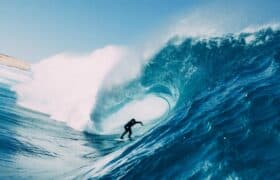


“This wave is as identifiable with Munich as the Glockenspiel."
The standing wave on the Eisbach River, the HQ of Munich’s surf scene for more than five decades and a magnet for surfers worldwide, including sexy Puerto Rican Dylan Graves, disappeared without warning last weekend after routine maintenance.
And no one knows why.
The Eisbach wave failed to reform on Friday after workers reopened sluice gates following an annual cleaning of the man-made canal in the Englischer Garten. In its place was a stretch of turbulent white water, unrideable and unrecognisable.
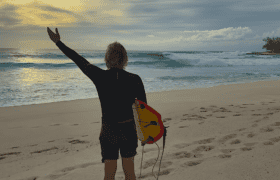
“It simply wasn’t there,” said Klaus Rudolf, 52, a lifelong surfer who has documented conditions at the site since 1987. Rudy was among dozens who gathered at the riverbank on Friday evening, boards in hand, only to watch the water rush past in chaotic surges.
City officials said the maintenance, which began on Oct. 31, followed standard procedure. Pumps lowered the water level to allow divers to remove debris — bicycles, bottles, sediment — that accumulates over the year.
When the canal was refilled on Nov. 1, engineers expected the wave to reappear, as it has reliably for decades, shaped by a concrete step and submerged wooden planks installed surreptitiously by surfers in the 1990s and later tolerated by the city.
Instead, preliminary surveys suggest that gravel displaced during the drain migrated downstream, flattening the hydraulic jump essential to the wave’s formation.
“The geometry is off by centimeters, but in river hydraulics, centimetres are everything,” said a hydrologist with the Bavarian State Office for the Environment.
The disappearance of the Eisbach wave is the second major disruption at the site this year.
In April, a 33-year-old surfer drowned after her leash snagged on the riverbed.
Witnesses described “dramatic scenes” where the woman cried for help before being repeatedly pulled underwater by the current. Her pals tried to get the leash off, the joint pushes 25k litres a second, but the force of the water made it impossible.
Standing wave form ’cause of a hydraulic jump, where fast-flowing water from a narrow, shallow channel slows abruptly as it encounters a deeper, wider section or an obstruction. At the Eisbach, this is caused by a concrete step and submerged blocks under a bridge near the Haus der Kunst museum. The rapid transition from what it is called supercritical (fast, shallow) to subcritical (slower, deeper) flow creates the standing wave.
Hell of a current in other words.
The woman’s death prompted a two-month closure, a civil lawsuit against the city, and new safety rules, including a ban on solo surfing and a curfew at 10 p.m. The wave reopened on July 1 with enhanced signage and quick-release leash requirements.
Tourism officials expressed concern over the loss of a landmark that draws visitors year-round. “This wave is as identifiable with Munich as the Glockenspiel,” said a spokeswoman for Munich Tourism.
Other important note: Did you know the joint is crowded? That localism is a thing? That Kelly Slater got told to go home by an arch local known as the House Meister? And so on?