

"Just before I gave up shooting surfing, a pale-faced Andy Irons took a month-long sabbatical in a rented property next door to my brother's place in Angourie."
A month ago, I saw an online post commemorating the passing of Andy Irons. It’s been 15 years since the world lost the best surfer I’ve ever seen surfing in real life.
This includes watching Michael Peterson winning the Coke contest at Fairy Bower in 1974. Cheyne Horan and Richard Cram shredding Bondi when we were in our teens and twenties. Surfing alone with Ronnie Burns at Outside Corner and Padang in 8 to 10 foot waves in ‘85. Shane Herring’s first surf on a Banana Board at South Avalon in ‘92. Kelly Slater coming first in the inaugural G-Land Pro in 1995. Mick Fanning free-surfing at Lennox Head in 2003. And 40 years of surfing Angourie with locals like Nat Young and regular visitors Joel Parkinson and Trent Munro.
These were the best ten surfing performances I had seen in the flesh. That is, until I shared the inside section at Hanalei Bay with Andy in December 2004. At which time they were relegated from 2nd to 11th.
The first wave I saw him on was like watching Nadia Comăneci get her first perfect ten at the Montreal Olympics on TV in 1976.

Never had I seen someone treat solid waves with such a combination of style, grace, and brazen contempt. Like a kid showing off at the top of his game on the monkey bars at his local park. Something akin to an overconfident male chimpanzee in the canopy of the jungle he grew up in.
Andy Irons swung around late and took off under the lip of a big one, got spat from the pit, jammed a fade, and then slammed into a violent bottom turn, and slashed away at the face like Zorro, passing by me smiling as he pulled into another tube. The look in his eyes was one of pure exhilaration. I felt like I had seen God.
We got about eight waves each before a few others, sitting and chatting outside, realised what the changing tide was doing and imposed themselves upon the most spiritual surfing experience of my life.
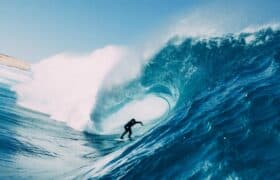
The scorching and searing gouges Andy Irons did under the lip, his concentrated faultless weaving inside the tube, way back in the belly of the beast, and his bizarre floaters over super long sections, during which he gyrated like he was on a disco dance floor, looked more like he was surfing the beach break, Pine Trees, at four foot, than those grinding eight foot barrels.
No words were spoken. It was perfect. Not a drop of water out of place.
When I occasionally tell my Australian friends this, I think that the reason they take it seriously isn’t that I’d seen and filmed so many great surfers. It’s because I’m an Australian, and they could only imagine how well he must have been surfing for me to concede that he was, for me, the best surfer of all time.
One asked me what I loved most about Andy’s surfing. That was simple. His style.

Not long after, I saw him on land on the North Shore of Oahu a few times and noticed he was struggling. Gone was the street kid at home, unselfconsciously enjoying his village life. He was being pestered by photographers and cameramen. Fans asked him to autograph T-shirts, strange objects, and risqué body parts. It looked like it was too much for him. He seemed like a small-town boy who’d made it big, and far from being bedazzled, he was completely overwhelmed. He looked distressed. Not that that stopped people from relentlessly pursuing and badgering him.
I had seen that very look before. Three acquaintances in the 80s. Jeremy Oxley, the lead vocalist from the band The Sunnyboys; a painter called Dale Frank, who went to art school at the same time as me, whose works went on to sell for tens and hundreds of thousands of dollars; and Jamie Packer, the son of the billionaire media mogul Kerry.
It was the confused look that asked, “Who are you? Do we know each other? Why do you like me so much if you don’t know me?” And the most tragic of all: “If you really knew me, you might not like me at all.”
It is the face of the irreparably broken-hearted.
Either they were genetically predisposed to it, like a kind of hereditary mental illness, or something truly tragic had happened when they were young, like childhood abuse, neglect, or rejection. Or all these things. They are constantly at risk of being triggered by something, or someone, even a misunderstanding.
Humiliation and fear of abandonment stalk them like a patient, maleficent shadow-self. Some can overcome this identity crisis; most can’t.
Beneath their glowing performances of confidence is a tragic insecurity. It’s the very fuel that drives them to stand out as such high achievers. It’s as if they’re screaming out: “I understand that I’m unlovable, but you can’t deny that what I am doing here and now is somehow worthwhile. Surely something that should be kept instead of thrown out. Like me.”
In short, they are broken. In psychological jargon, they don’t think they have made mistakes in their lives; they believe they are a mistake. They don’t think that they have done bad things in their lives; they believe they are intrinsically and irredeemably bad.
Just before I gave up shooting surfing, a pale-faced and washed-up-looking Andy took a sabbatical, without a photographer or camera crew, and stayed for a month in a rented property next door to my brother John’s place in Angourie. I was living down the road and still had all my camera gear and was tempted to introduce myself and ask him if I could follow him around and film him free-surfing.
I knew I was about to give up making surfing films, as I had just got married and started having children, and after a few good surfs together, I saw that the look in his eye from Hanalei Bay had returned. But I didn’t want to risk nudging him from that childlike unselfconsciousness into its jaded adult opposite.
What followed was far more thrilling than making my swansong surf film. I got to see Andy having fun as he discovered a whole new coastline, from popular to remote surf breaks. Obviously, his surfing was brilliant.
With joyful abandon he eviscerated and excoriated unsuspecting northern NSW surf spots like Jack the Ripper disemboweling East End Ladies of the Night.
But it was far more enjoyable for us that he was enjoying himself. It was like he was a kid again, laughing and joking around and having fun.
In short, he remembered who he was.
During all those surfs we had together, I never introduced myself. He looked like he was having too much fun to be interrupted by someone from the dreaded surfing industry he appeared to be escaping from. Not that he would have had any idea who I was. I was just another Australian bloke in the water, happily sharing waves while watching him come back to life.
He became more animated on land. The colour returned to his face, like vibrant coral, that, although life had almost been completely sucked and then bleached out of it, had come back from the brink, and was enjoying its time in the sun.
For me, it was like deciding not to video Mozart on my iPhone from the front row, and instead to drink in the live experience. Intoxicating.
RIP AI
Commented on Disqus? Log out, tap the Disqus button, and your old name and comments come back. The box is ours.
Your comments are still here. Every one of them.
Twelve years of BeachGrit comments came across from Disqus. Connect and we will show you how many are yours. We get your username, nothing else.
Connect Disqus to reveal.
This is the Melekian article that everyone should read if they haven’t:
https://www.outsideonline.com/outdoor-adventure/water-activities/last-drop/
One of the best things I’ve read on BG, ever. Thanks mate.
… great piece Monty. Thank you.
OMG! Richard Cram. Witnessed tonnes of incredible surfing, however none discombobulated my then grommet brain, as first encounter with the Cram cutback!
May explain my life of on/off mental illness …?
Notable additions…
Kevin Davidson: speed, technique and, ballerinaesque beauty.
Steve Wilson: controlled aggression
Sunny Abberton: (see above)
Damn that was a lot better than the shark story. Probs should stick to non-fiction
Radical surfer, I loved watching him surf. Not sure if I ever saw him live. Maybe at a comp. After a while it all becomes a blur.
Sometimes we get stuck into the trap of thinking that “great sportsperson = great person”. There were enough stories in the press when he burst on (then quickly off) the scene the first time. These kind of got squashed when he started surfing for Billabong and there’s that article (on Stab?) that got the author in trouble and the bio that never got published. Well worth tracking down because it’s warts and all. Or just watch Blue Horizon and make up your own mind.
Best piece of writing on Grit in months. I’d buy the author a HamSammish.
A real sad part of this ordeal is how Bruce still being unable to get clean shows just how fucked addiction really is. Fuck me cunt your older brother who you worshipped OD d in a shit heap hotel room on his own, in the middle of America without ever seeing his son. If being a role model, inspiration and guiding light for your dad less nephew isnt enough motivation then I can’t see anything making ya kick your habits. Fiends gonna fiend I guess
Great story!
Watched him v guilherme herdy at cloudbreak 04. done this clinical roundhouse on a 6ft+ section. Hit the rebound with such precision & commitment. No hesitation whatsoever ever. Blew me away
Saw Bruce and Andy at my local doing a HSA contest when they were around 13-14. Absolute freaks already.
Great surfer Tainted legacy
Industry to blame
Still to this day
Industry did nothing to help. Don’t know if it’s to blame.
Men make choices.
Thanks for the read, Monty. Never had the chance to surf with him but yeah, watching him take apart that big peak outside Pinetrees (can’t remember what they call it) was mind-altering, like he was playing at “4foot Pinetrees”. Not sure bout your psychoanalysis but folks in this sphere sure seem to valorize dissociation, some go harder than others.
“Mahina” they called it?
Best style and casual grace in heavy / pumping surf, of all time, RIP Andy
Loved this, very well done.
Thanks Monty. That was great.
Fantastic stuff! Good on ya DR for running. I just have one question. Brilliantly put together, but the last closing line. What does wishing for the end of Artificial Intelligence have to do with him and his legacy?
Not sure what’s weirder. The creepy stalking or the jack the ripper metaphor.
Great read
Glad you ditched the shark histrionics and the ridiculous below-the-line-bashing epilogue.
Also, floaters are criminally underrated.
Not sure about the psycho-analysis- it might be true or it might be BS and AI isn’t around to answer for himself .
If AI really considered himself unlovable it’s doubtful he’d get a babe like Lyndie to marry him.
Drug addiction got him, thats all we know for certain.
As for the rest pretty spot on I reckon.
He showed up at the Point here one cyclone swell- 6-8ft big square sections and and went skitz.
Deffo the best surfing I’ve ever seen live.
Brenden Margieson, Australia’s AI minus, mostly, the out of the water histrionics. Agree or no?
One won world titles, the other looked good in billabong ads. Both great surfers, but comparably, chalk & cheese
& yeh surf movies from then were effectly ads.
Yep, agree.
for me Margo , a shade better than Dane K , Wayne L, BK, Andy,Occy’, Curren……currently JJF/Italo/Gabs…..ah the subjectiveness of it all….
Hard to compare when board eras dictated performance limits. Dane for power, Buttons for “WTF was that?”, and Rell Sunn and Buddy Boy for style.
I’m lucky and get to see the mighty Margo surf heaps and he is still fucking ripping. He is definitely in my top 3 favorite Strayan surfers of all time along with Taj and Joel
I remember seeing Brendan do a reverse out the front of his parents place as a 16 year old about 6 months prior to the movie Kelly Slater in black and white and we had no name for it. One of the most talented that ever came out of Byron and yet still thought he was not that good of a surfer.
Just makes me shake me head and think what was that fake shark bullshit all about haha