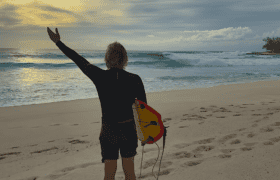


"This man, Ilima Kalama, is the highest order of any ocean spirit in human form I have ever had the privilege and honor of spending time with."
Surfing is extremely fortunate to have its share of legends. Amongst them, Iliama Kalama, father of Dave Kalama. He passed on, yesterday, but tales of his daring-do will certainly reverberate. Here, author Chris Dixon shares an excerpt from his very fine Ghost Wave about the discovery of Cortes Bank.
Kenny Cohen took at least one more waterman out for his very last dive above the Cortes Bank—a compact, powerfully built Hawaiian with a perennial smile on his face named Ilima Kalama. Like Rex Bank’s, his story is a lesson in how a big wave surf spot builds its reputation—by humbling the toughest characters in a small world built on pride and guts.
Kalama was born on Oahu and now lives on Maui. He comes from a long line of Hawaiian heavy watermen. His son Dave is a highly regarded surfer who for a decade and a half was the low-key towsurfing partner of big wave legend Laird Hamilton. Ilima’s father, Noah, was also a renowned waterman who, in 1958, loaded up the family and moved to Newport Beach, California, bringing the sport of outrigger canoe racing to the mainland. Ilima rabidly surfed Orange County’s chilly water through high school and won the West Coast Surfing Championships in 1962.
In 1963, while working as a lifeguard, Ilima was asked to pen the liner notes to a genre-defining album by the Ventures, a work of blazing guitars simply titled Surfing.
Surfing is more than just a sport . . . it’s a fever. Surfing has become a state of mind . . . a wild, uninhibited existence that revolves around the sun, the surf, and the sand. . . . Plummeting down a hill of moving green water and being able to move your board right or left—up or down—is feeling akin to flying, to skiing, and to sailing. The difference in surfing is that not only are you moving, but the force you’ve harnessed is also moving. . . . The life of a surfer has a definite rhythm and beat to it . . . the beat of the surf and the beat of the wild, driving music he listens to. More than any other group, the Ventures have this sound . . . the beat of the surfer and the sound that he associates with the driving ride through the curl. . . a wipe-out . . . the life of the beach.
In 1966, Kalama joined a big, solid waterman named Larry Doyle on his first aba lone dive out to the Cortes Bank. “I met some friends who were ab diving out of San Pedro,” he said. “Hawaiian boys—former black coral divers. Oh, there were lots of pinks and reds at Cortes Bank. They were fetching about five dollars a pound, and there was lots of money to be made. The diving out there was amazing. I mostly remember how the water was just the most beautiful blue. Along the bottom it was rocks and sand and where we mostly dove, the surface was fairly flat and regular. There was no big tree kelp, more just small palm kelp. We went out probably three to four times on calm days and had good experiences.”
On a placid morning in early 1971, Kalama climbed aboard the Sea Way, Larry Doyle’s twenty-seven-foot cabin cruiser. When they reached Cortes Bank, they found four other abalone boats scattered around, and set anchor in thirty-five feet of water with the clanging Bishop Rock bell buoy in the near distance.
It was still daylight, so they both decided to climb into their gear and dive. “We found a hot spot,” Kalama said. “I brought up twenty-four or twenty-five dozen. Larry made a dive and came up with about the same.”
Around midnight, Doyle awoke Kalama to tell him that the seas were getting rough. Other boats were leaving and Doyle thought it prudent to do the same. Kalama thought otherwise. He told Doyle that despite steep wind waves that were lapping over the boat’s bow, they should just wait till the next morning so they could lever another motherlode off the rocks.
“Five hours later, he wakes me up again and says, ‘Ilima, the boat’s sinking.’ The water’s up to my knees. I told him to call the Coast Guard and to tell them that we’re at the Bank, that we’re sinking, and that we were going to try to swim to the bell buoy.”
A few minutes later, the Sea Way disappeared beneath its fully clothed crew, leaving them to swim in breathtakingly cold water that Kalama reckons hovered in the high forties—a temperature capable of inducing hypothermia in a matter of minutes. Kalama was so disoriented that it took a while to realize that the reason he could barely swim was because he was still wearing his boots. He kicked them off. Then, after a few minutes in the water, as things seemed utterly bleak, came the epitome of a miracle. Both men’s thick, hooded wetsuits unexpectedly corked to the surface like Queequeg’s coffin in Moby Dick. They shed their clothes and climbed in.
The men next made a desperate swim for the blinking Bishop Rock buoy, but the black sea was a combat zone of steep, short-interval 12-foot swells, smothering whitecaps, and strong currents. They were rapidly swept out into the open ocean.
“I’ve been out in the water in big waves,” Kalama said. “Makaha and Sunset. I’ve been near death and near drowning, but none of that was even close to this. Larry was swimming right next to me. I told him to relax, and after a few minutes I started trying to crack jokes. We were drifting toward San Clemente Island.”
Kalama didn’t know it, but the situation was still beyond grim. In his near panic, Doyle had forgotten to give the boat’s name or identifying number in his mayday broadcast. The Coast Guard ignored the call. The light of morning revealed a sight of terrifying desolation. The other boats were gone. The men were tiny, insignificant creatures, treading alone atop a vast ocean.
Kalama thought about his family—his wife, young son, and daughter—wondering if God would ever grant him the privilege of laying eyes on them again. He directed his prayers toward his mother, who had recently passed away.
“My mom—I felt she was out there with me,” he continued, his voice breaking.
“That mana. That spirit. I felt so at ease. It was sort of, what will be, will be.”
They bobbed alone for perhaps a couple of hours. Then in the far distance, they saw a lone fishing boat. It appeared to be motoring slowly but generally in their direction. It disappeared in the troughs of the steep swells, but when boat and diver were simultaneously borne to a wave’s crest, it would reappear, each time slightly closer. After an hour or so, she was perhaps a mile off. Then, unexpectedly, she veered away. “Our hearts just dropped,” Kalama said.
Kalama and Doyle reached a decision. They would attempt the forty-mile swim to San Clemente Island. The effort itself would offer them some sort of hope—something to focus on. Yet deep down, Kalama knew this was essentially impossible. He had canoe-paddled the brutal twenty miles from the mainland to Catalina Island, and the relentless twenty-six miles of wind and current that separated the Hawaiian islands of Molokai and Oahu. What were the odds of swimming forty miles to San Clemente? But if they continued simply treading water, slowly bleeding heat into the Pacific, their chances were zero.
Then the fishing vessel reappeared to the south. Her captain had chanced to have his radio tuned to Doyle’s channel during the mayday. He recognized the panic in the mariner’s voice and proceeded toward Bishop Rock, where he eventually sighted a small but telling oil slick and, shortly thereafter, a floating hatch cover. He commenced a zigzag transect of the waters. A couple of hours later, he was shocked when he literally stumbled upon two men bobbing in mile-deep water. Their death march had ended just in time for lunch.
A month or so later, Kalama did something that I’ve found an astonishing hallmark of many who’ve nearly died at the Cortes Bank. He simply couldn’t ignore the sirens—and went back.
“After we got saved and came back in, I was able to get on another boat,” Kalama said. “I wanted to dive again at the same spot—because if I’m going to dive again, I wanted to do it where we sank. I went with another fella, Kenny Cohen. When we got out there, we saw that the waves were up. Cortes was breaking—the first time I’d seen it break. It was a good 25 feet, perfect rights.
Perfect.
I wish I had friends out there with me to go surf. It was just an amazing sight.”
Because of the current and turbulence the swell was bringing in the shallower water, it was impossible to free dive at the usual depth of thirty to thirty-five feet. They dove without scuba tanks down to ninety or a hundred feet, where the currents were somewhat manageable. “All that time, when I came up, I could see the waves breaking just five hundred yards away,” Kalama said.
“When we were done that afternoon, we anchored, and wouldn’t you know it, at one or two in the morning, the wind and ocean got rough. I pulled anchor and the ocean was almost washing over the back of the boat. It was the slowest we ever went to San Clemente Island. Kenny and me were just getting pounded left and right. You can’t believe how many Lord’s prayers I said on that trip. After that, I hung it up. I said to myself, I think Akua wants me to stay on land.”
As we spoke, Kalama grew quiet for a moment. He had, it seemed, been granted freedom from the belly of the whale not once, but twice. “You know, I grew up respecting the ocean. I was taught by the very best watermen in the world. When my buddy woke me up that night at midnight, we should have left. It was greed that made me want to stay longer. I totally disrespected myself and disrespected the ocean, and I should have known better. I just thank God that in spite of that wrong choice that I’m here to talk about it. Thank God. Mahalo Ke Akua. To this day, no matter what I do, I cannot thank Him enough for the goodness and happiness I’ve received my whole life. I’m so thankful and so blessed. No matter what I try to do, I can never give back enough.”
When Ilima Kalama speaks of greed and respect, and the fatal dangers that can follow an unwise decision, he captures an essential element of life atop the Cortes Bank. Bishop Rock’s litter of wrecked boats, Larry Doyle’s among them, are testament to this. Yet two far larger ships have also met the Rock. Both misadventures, one a near disaster and one an outright fiasco, would only add to the Bank’s ominous legend.
Commented on Disqus? Log out, tap the Disqus button, and your old name and comments come back. The box is ours.
Your comments are still here. Every one of them.
Twelve years of BeachGrit comments came across from Disqus. Connect and we will show you how many are yours. We get your username, nothing else.
Connect Disqus to reveal.
Gnar!!!
Vale Kalama
Holy shit Chris this was good. Book must be the real deal. Well done.
How about an update on Sasha’s onlyfans career with pics?
What a badass
great article Chris. Thanks for this.
God bless Ilima.
Chris is a great author (and person). If you haven’t read Ghost Wave, I highly recommend it.
Absolutely.
Thx Barreled. And if you haven’t read Blessed be the Bank Robbers – because you’ve surely already read Cocaine and Welcome to Paradise – make it so. Chas’s family is the west coast version of the Gemstones – with a righteous dose of H. I. and Ed McDunnough thrown in.